
By Vitaly Ataev Troshin
By the time my dog, Jeron, and I reached the car, it was about eight in the evening and we were walking by moonlight. We had two lights and water left. Cell service was gone, the location marker on my phone stopped updating, and the path was hard to make out on the steep, rocky slopes. Getting back took about three hours. I scraped my hands and, by the end, Jeron was reluctant to go any farther.
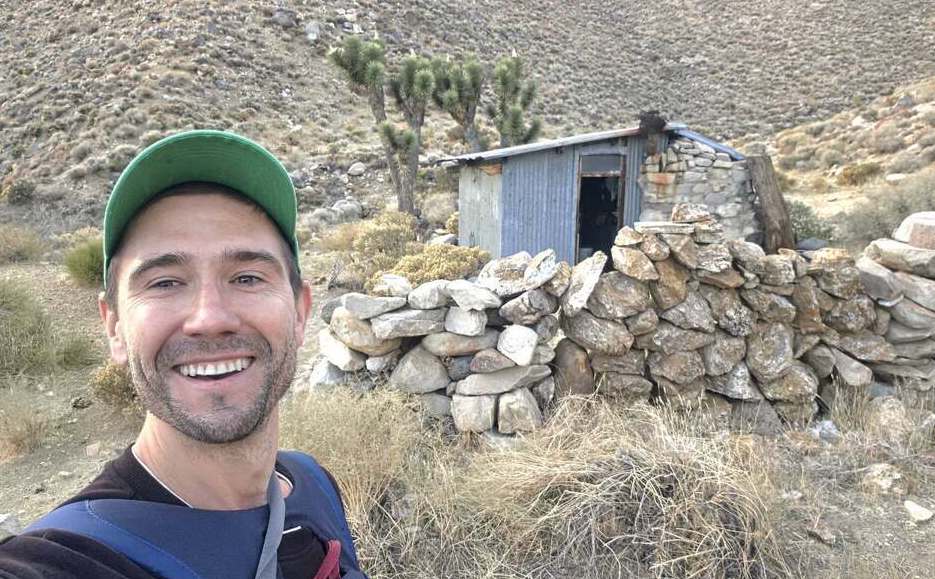
Hours earlier, on November 15, 2026, I had reached the cabin I’d spent nearly five years looking for. Known as Russian Cabin, it stands in the Homewood Canyon area north of Trona, in Inyo County. Local lore associates it with a man nicknamed the “Mad Russian” and, in one version, describes him as a Soviet immigrant who came to prospect for gold. His identity and connection to mining remain unverified.
Finding the cabin
I first heard about it in 2021. The people I talked to knew fragments of the story, but nobody I spoke with then could pinpoint the building. I made several fruitless trips. In November 2026, I corresponded with Nicholas Blake, Lynne Buckner and Karen Rusiniak. Ruby Spring became a useful landmark. Hikers from San Francisco also called shortly before my trip and pointed me to the area on a map.
At the cabin, I photographed the walls and interior and took aerial footage. Inside were a stove and calendars that appeared to date from 1966 and 1995. Those dates, if confirmed, would date the calendars themselves. Who brought them there remains unknown. Before leaving, I set down a copy of Russian California and a small flag. I passed old mine workings on the way, but found no evidence tying a particular mine to the person in the local accounts.
One name, possibly two cabins
In June 1988, rescuers searching for Kevin Tate went to Ruby Springs after learning that he had spent time near an old shed known as Russian Cabin. The search report says the cabin had been destroyed by the time the team arrived. The report provides no precise location for the shed. China Lake Mountain Rescue Group, operation 88-10.
Hikers reached a standing cabin in the area in November 2022. Their account, published in the spring 2023 issue of The Survivor, describes pencil writing on metal siding, with references to Russia, Germany, the United States and World War II. The account uses the names Russian Cabin and Rusky Cabin. Was an earlier structure rebuilt, or did two buildings share the name? Dated photographs from the intervening years could help answer that question. The author of the inscriptions also remains unknown. The Survivor, spring 2023, page 13.
What the search record can establish
The 1988 account records a decision made during a missing-person search. The rescue team was looking for Kevin Tate, who knew the mines and springs around Homewood Canyon. Ruby Springs was one of several places the teams checked. The entry documents what rescuers were told about his connection to the old shed and what they reported finding when they arrived. It gives us an early use of the name Russian Cabin and a geographic clue. A field map, a photograph or a description of the shed’s construction could help tie that clue to a specific site.
What the walls might tell us
The 2022 hikers left a different kind of record. Their account describes a long day in the canyon and a cabin that was difficult to find even with two GPS devices. Its photographs give us a point of comparison for the exterior and the pencil marks. The next step is to match individual panels and inscriptions against the 2026 images. A dated photograph can show that a line was already there by a particular visit. Readable names, dates or references might lead to records, though a date mentioned in a line could refer to an event decades before the line was written.
There are several questions bound up in the local nickname. Who first used it? Did that person know the occupant? Did the occupant build the cabin, or move into an existing shelter? Did one person write all the lines? The published hiking account raises many of those questions itself. The wall writing and the story of a Soviet immigrant prospecting for gold are leads we can follow through photographs, oral histories and mining records. An independently dated record linking a named person to the property would be a major advance.
Getting to Homewood Canyon
From Ridgecrest, follow the State Route 178 corridor toward Trona. North of Trona, continue on Trona–Wildrose Road. The small sign at the Homewood Canyon turnoff is easy to miss. The canyon lies outside Death Valley National Park. Farther along the same corridor is a separate turnoff for Ballarat, a former mining settlement and ghost town. Trona is a place to stop for fuel and supplies.
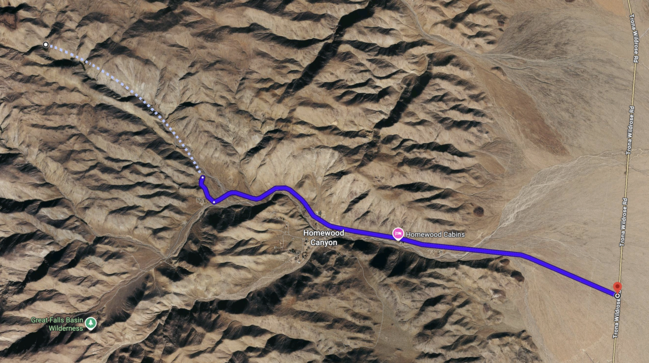
I left my vehicle where the road ended. Legal parking and public pedestrian access at that point are still being checked. The approach passes near homes and private parcels. The faint path disappears in places and some slopes end in abrupt drop-offs. In daylight, with the path in view and a steady pace, I estimate the walk could take about 90 minutes. From the end of the road, I would budget two to two and a half hours each way based on my experience. Keep clear of mine openings and barriers, set out early, and bring drinking water, lights and offline maps. USGS topographic map · BLM safety guidance.
What the map shows
On the satellite view, the approach branches west from Trona–Wildrose Road into Homewood Canyon. Farther in, Alpha Spring and Ruby Spring are landmarks on the USGS topographic map. The dotted line on the Google Maps screenshot is a visual guide toward Ruby Spring. It does not establish that there is a continuous trail, that it follows the line, or that visitors have permission to cross the land. The end of the plotted driving directions also does not establish a public parking area.
In daylight, I could make out sections of the path. After sunset, the slopes and drop-offs were harder to read with our lights, and the return took roughly three hours. My phone’s location marker stopped updating in an area without cell service. That was my experience on this trip. The times above are estimates, and the condition of the path can make a substantial difference.
Can the site be protected?
California58 and Russian California have asked the Bureau of Land Management and Inyo County about land jurisdiction, public access and whether anyone has proposed marking a trail. We asked California’s Office of Historic Preservation how the cabin might be documented or evaluated, and requested archival material and accounts from the Eastern California Museum, Desert Survivors and the China Lake Mountain Rescue Group.
How readers can help identify the cabin
A dated photograph that shows both the building and the surrounding terrain could help establish where an earlier cabin stood. Details such as the roofline, wall materials and its position relative to the spring may allow comparisons even when a photograph has no coordinates. We are especially interested in images taken before the 1988 search or between that operation and the 2022 hike.
Firsthand accounts could also help. When did you visit? What did the building look like? Who first told you the name Russian Cabin? The answers could help trace the nickname and distinguish people who knew the occupant from those who heard the story later.
One question for land managers is how to document the writing in place and whether protection is practical. Another is whether the road’s terminus offers lawful parking and access for a designated foot route. Those questions affect different decisions, and the cabin’s potential historical significance alone would not establish public access.
If you have dated photographs, can identify any of the wall inscriptions, or remember an earlier cabin near Ruby Spring, contact california58com@gmail.com.
Support California58
Choose how to support California58:
Credit / Debit Card via StripeChoose your contribution amount on the secure California58 Stripe checkout. One-time support for independent local journalism.
Continue with PayPal Continue with ZelleZelle payments go to Vitaly Ataev Troshin. Please verify the recipient in your bank before sending. Availability depends on your bank.
Optional reader support. Contributions are not advertised as tax-deductible. Support does not influence editorial decisions.USEFUL SERVICES
Useful services from our ecosystem
AFFILIATED RESOURCE
Travel smarter worldwide
OptionTripAI-powered trip planning for journeys in California and around the world.
Explore OptionTrip →AFFILIATED RESOURCE
Free tax & property tools
TaxesTimeFree preliminary tax and property tools, including the Property Tax Savings Report.
Explore TaxesTime →AFFILIATED RESOURCE
California document support
LegalDocSVCDocument preparation support for self-represented Californians. Not a law firm and not legal advice.
Explore LegalDocSVC →WORK WITH CALIFORNIA58
Have a story, project or partnership idea?
California58 welcomes news tips, interviews, video projects, community partnerships, advertising and other California-focused collaborations.
Work with California58 →
COMMUNITY
Comments
Join the California58 conversation. You must be signed in to comment.
Create a free California58 account or sign in with an available social provider.