
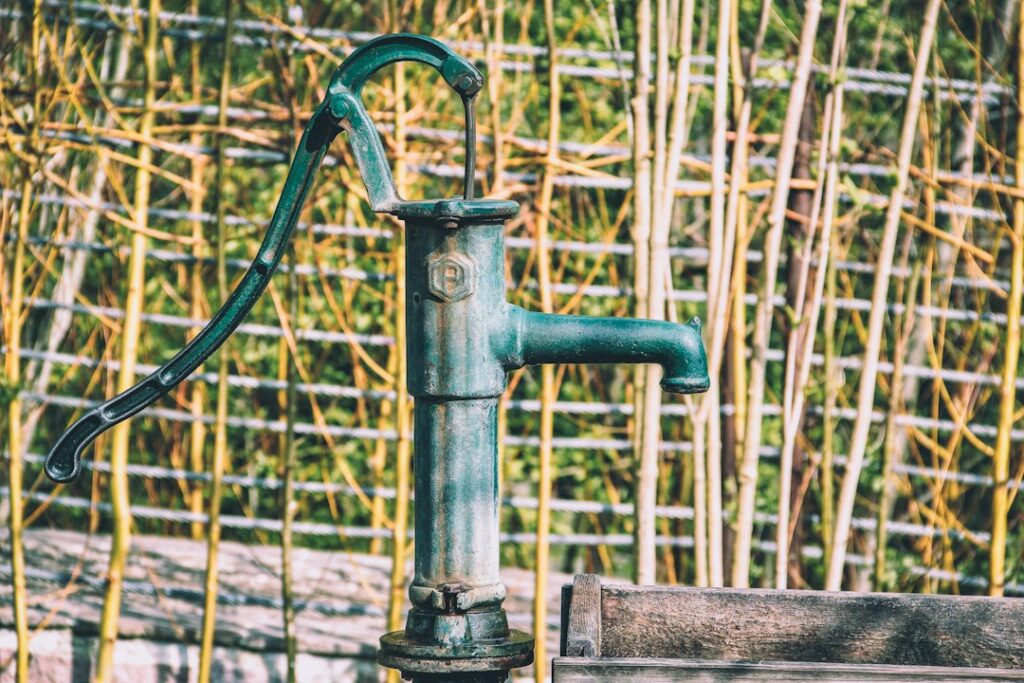
Featured photo: traditional water pump by Herbert Goetsch / Unsplash. Illustrative only; not a photograph of a modern, permitted Red Mountain residential well.
RED MOUNTAIN NEWS | WATER & RURAL PROPERTY | OCTOBER 19, 2026. A private well may be essential for a remote desert property, but buying land around Red Mountain does not guarantee groundwater is available, that a well can legally be drilled, or that water will be safe to drink untreated. In 2026, the San Bernardino County Environmental Health Services program requires permits for well construction and recommends ongoing water-quality tests. These questions carry particular importance in a region with a legacy of historic mining, while nearby mine records alone cannot determine the safety of a specific household well.
Does drilling a well require permission?
Yes. San Bernardino County Environmental Health Services says a permit is required for construction, destruction or rehabilitation of a well. Its published instructions state that the application must be signed by the landowner and a licensed C-57 well driller registered with the county. In some desert-region circumstances, separate groundwater-well restrictions or discretionary approvals may also be relevant; property owners should ask county staff to identify every approval required for the precise parcel before contracting for drilling.
What water-quality testing does the county recommend?
The county recommends annual testing for bacteria and nitrates and other contaminants of concern, which can include arsenic, fluoride, iron, manganese and sulfur. A qualified laboratory can help select tests appropriate to local geology, historic activity and the water source. Use a state-certified laboratory for drinking-water analysis and retain the results. A test taken from someone else’s property is not a substitute for testing your own well.
Does a mining district mean every well has arsenic?
No. BLM records document arsenic concerns in specified historic mine waste and wash areas within the Rand Historic Mining Complex. That does not prove arsenic concentrations in a particular drinking-water well. Arsenic and other dissolved constituents can also have naturally occurring geological sources. The only sensible answer for a household is appropriate laboratory testing and professional interpretation of results, rather than assumptions drawn from a map or news story.
Before drilling: five specific questions
- Can the property legally support a new well? Ask Environmental Health Services about the permit, siting requirements and any applicable desert groundwater ordinances.
- Will the water supply be adequate? Seek local hydrogeologic expertise about potential yield, seasonal conditions and reasonable costs. Neighboring well reports can help inform research but are not a guarantee.
- Where can the well be placed? Confirm required separation from septic components, drainage areas, potential contamination sources and property boundaries.
- What tests are appropriate? Discuss bacteria, nitrates and site-relevant metals and minerals with a certified laboratory.
- What will happen if results exceed a drinking-water standard? Understand treatment, an alternative approved water source, retesting and long-term maintenance costs before the purchase becomes nonrefundable.
Can a new home depend on delivered trucked-in water?
The county explains that, subject to a narrow pre-2018 reconstruction exception, California Water Code Section 106.4(c) limits new residential building permits where hauled water is intended as the water supply. That means a buyer should not assume a storage tank filled by delivery trucks will satisfy residential water requirements. Existing properties, alterations and reconstruction have their own fact-specific histories; get a written determination before relying on a particular arrangement.
Maintenance for existing well owners
San Bernardino County recommends periodic pump performance checks and annual water testing. Pay attention to changes in odor, appearance, pressure or taste, but remember that some contaminants have no visible sign or distinctive taste. Do not rely on boiling to remove arsenic or similar dissolved chemicals. If testing identifies a contaminant, obtain treatment guidance appropriate to that laboratory result.
Where to get applications and contacts
See San Bernardino County’s Water Wells FAQ and Safe Drinking Water program. Environmental Health Services lists its general information number as 1-800-442-2283. California’s Department of Water Resources explains well construction standards and professional licensing.
Additional Red Mountain context
Our companion Kelly Silver Mine records investigation explains what federal mine-remediation documents do and do not establish. The Red Mountain zoning guide outlines the other approvals involved in planning a home.
Primary sources: San Bernardino County water-well guidance, county safe drinking-water program, California DWR well basics. This is public information, not a site-specific laboratory finding or water supply guarantee.
Support Red Mountain News
Choose how to support Red Mountain News:
Credit / Debit Card via StripeChoose an amount from $1. One-time support through the publisher's LINKERNO Stripe account.
Continue with PayPalZelle323-677-7643Open Zelle through your bank. Verify the recipient before sending.
Optional reader support. When possible, add “Red Mountain News” to the payment note. Contributions are not advertised as tax-deductible. Support does not influence editorial decisions.More from Red Mountain News
- Red Mountain News: 42 Test Drill Holes Proposed at St. Elmo Mine — What County Records Actually Approve →
- Red Mountain News: How to Check Land Zoning, Legal Lots and Building Permits in 2026 →
- Red Mountain News: San Bernardino County’s 2026 Emergency Campaign Puts Rural Desert Alerts in Focus →
- Red Mountain News Investigation: What Federal Records Say About Arsenic and the Kelly Silver Mine Cleanup →
- Red Mountain News: 2026 BLM Off-Road Rules Bring New Route Closures and a Free Rand Mountains Permit →
COMMUNITY
Comments
Join the California58 conversation. You must be signed in to comment.
Create a free California58 account or sign in with an available social provider.