
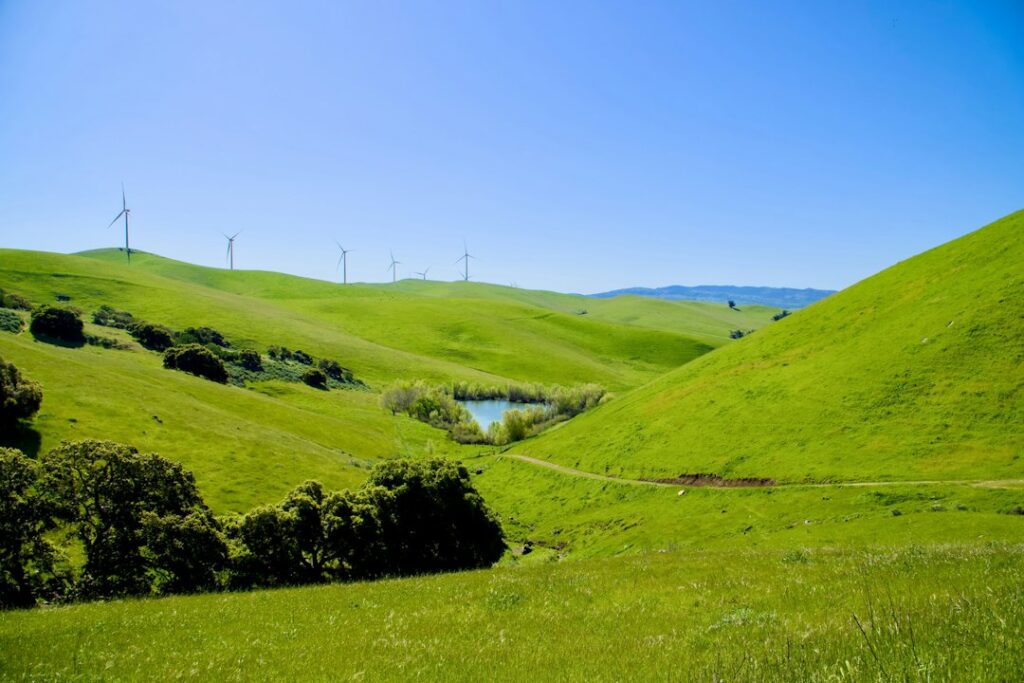
Featured photo: green hills and pond by Spencer DeMera / Unsplash. Illustrative only; not a documented conservation easement parcel.
CALIFORNIA58 | LAND OWNERSHIP & CONSERVATION | OCTOBER 18, 2026. A California property can be privately owned, have a valid assessor parcel number and still be subject to a conservation easement that restricts future development. Buyers of ranches, woodland, agricultural land and other rural property should review recorded conservation documents before assuming they can clear, grade, subdivide or build.
What is a conservation easement?
Under California law, a conservation easement is a nonpossessory interest in real property that may be created to retain land in natural, scenic, historical, agricultural, forested or open-space condition, among other qualifying conservation purposes. California’s Civil Code Sections 815–816 establish a framework for conservation easements. The terms of the recorded instrument are central to understanding restrictions on a particular parcel.
What could be restricted?
Depending on the recorded agreement, an easement may limit new residences, accessory structures, commercial uses, vegetation removal, grading, road construction, subdivision or other activities. Some easements reserve a designated building envelope or allow specific agricultural operations. Others are substantially more restrictive. There is no universal list of permitted uses: read the actual document and amendments.
Who can enforce the restriction?
Conservation easements are commonly held by qualifying governmental entities or nonprofit organizations. The recorded instrument and applicable law identify the holder and the relevant enforcement rights. A seller’s informal assurance that a restriction is no longer important should not replace confirmation from the easement holder and qualified counsel.
Five due-diligence steps
- Order a preliminary title report. Look for conservation easements, deed restrictions, recorded maps and referenced documents.
- Get the complete recorded instrument. Review exhibits, legal descriptions, maps, amendments and any reserved building areas.
- Contact the easement holder. Ask about the proposed use, written approvals, management plans and past compliance issues.
- Check local planning and zoning separately. Even if a county permits a home under zoning, the private or public conservation restriction may prohibit it.
- Ask about ongoing obligations. Maintenance, monitoring access, restoration and approval procedures may be addressed by the agreement.
Can the restriction be removed when the land is sold?
Do not assume so. Conservation easements are often designed to bind future owners. Modification or termination may be legally limited and can require the holder’s participation, judicial proceedings or other conditions depending on the facts and applicable law. A purchase transaction does not ordinarily erase a properly recorded easement.
How does this differ from the Williamson Act?
A conservation easement is a recorded property interest governed by its terms and applicable law. A Williamson Act agricultural conservation contract is a distinct statutory arrangement with its own use restrictions and contract terms. A parcel may involve one, both or neither; investigate each separately.
What about donated easements and tax benefits?
Tax consequences of conservation easements are highly fact-specific and can involve complex federal and state requirements. Do not assume a tax deduction, reduction in assessed value or financial benefit without advice from qualified tax and property professionals.
Before you buy
Ask for all recorded documents and seek written parcel-specific answers about the intended use. If the land’s value depends on a future home, driveway, grading or subdivision, make that feasibility investigation a priority before the purchase becomes nonrefundable. See our legal-parcel guide, grading-permit explainer and mineral-rights checklist.
Primary law: California Civil Code, conservation easements. This is general public information, not legal or tax advice or an interpretation of any specific recorded agreement.
USEFUL SERVICES
Useful services from our ecosystem
AFFILIATED RESOURCE
Travel smarter worldwide
OptionTripAI-powered trip planning for journeys in California and around the world.
Explore OptionTrip →AFFILIATED RESOURCE
Free tax & property tools
TaxesTimeFree preliminary tax and property tools, including the Property Tax Savings Report.
Explore TaxesTime →AFFILIATED RESOURCE
California document support
LegalDocSVCDocument preparation support for self-represented Californians. Not a law firm and not legal advice.
Explore LegalDocSVC →WORK WITH CALIFORNIA58
Have a story, project or partnership idea?
California58 welcomes news tips, interviews, video projects, community partnerships, advertising and other California-focused collaborations.
Work with California58 →
COMMUNITY
Comments
Join the California58 conversation. You must be signed in to comment.
Create a free California58 account or sign in with an available social provider.