
CALIFORNIA58 ELECTION LAW GUIDE | Updated October 22, 2026. Political yard signs, roadside campaign posters, large billboards and ballot-measure advertisements are visible across California as the November 3, 2026 general election approaches. But can anyone put a sign beside a highway, on a public sidewalk or in a neighbor’s yard? Must every sign say who paid for it? Can a landlord or homeowners association require a resident to take down a poster? And who removes signs once the election is over?
The answer depends on the land, the type of sign, who is paying for the message, and the city or county where it stands. A Caltrans rule for certain highway-adjacent temporary political signs is not a blanket law governing every political message in every front yard. California58 reviewed California Secretary of State, Caltrans, California Fair Political Practices Commission (FPPC), and state Civil Code guidance, plus 2026 city policies, to separate these requirements.
At a glance: The political sign rules California residents should know
- Private property: Campaigns generally need the owner’s or authorized occupant’s permission; comply with local sign rules and sightline/safety laws. Being visible from the street does not make private land a free public posting area.
- State highway right-of-way: Temporary campaign signs are prohibited there. Private land next to some highways can be subject to Caltrans conditions.
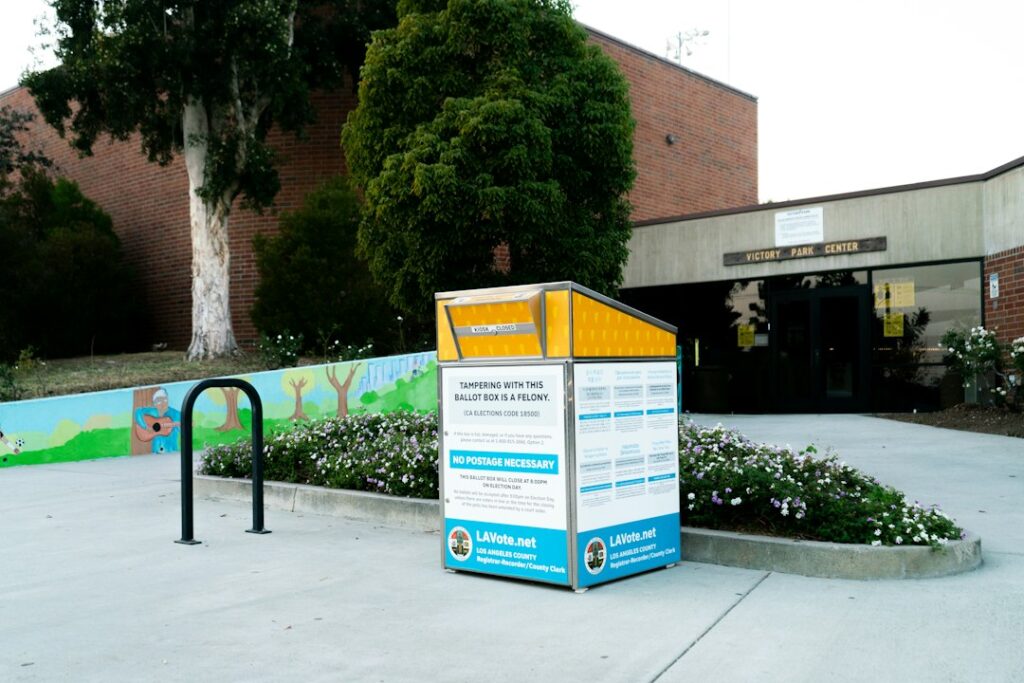
- Polling places and ballot drop boxes: California’s anti-electioneering restrictions generally cover campaign advocacy within 100 feet of designated voting locations while voting is occurring.
- Paid political advertising: The disclosures depend on who pays — a candidate committee, ballot-measure committee, party or independent-expenditure committee. Do not assume every ordinary candidate yard sign legally needs identical “Paid for by” wording.
- After November 3: Removal deadlines vary by ordinance. Caltrans’ specified temporary political-sign exemption uses 10 days after the election; some cities set a different period.
- Removing a questionable sign: Take a photograph, record the location, and contact the property owner or authorized public agency. A passerby should not simply remove, destroy or deface a sign because they disagree with its politics.
1. Roadside signs: What Caltrans actually requires
California Business and Professions Code Section 5405.3 creates an exemption from ordinary outdoor-advertising rules for qualifying temporary political signs. Caltrans says such a sign must encourage a particular vote in a scheduled election, be displayed no earlier than 90 days before that election and removed within 10 days afterward, be no larger than 32 square feet, and be covered by a filed Statement of Responsibility identifying who will remove the signs and reimburse improper-removal costs.
For the November 3, 2026 election, those 90-day and 10-day dates correspond to August 5 and November 13, 2026. They apply to the Section 5405.3 exemption and do not automatically establish identical dates for every residential yard sign or permanent commercial billboard.
Where signs cannot go: Caltrans prohibits temporary campaign signs inside a state highway right-of-way. It also prohibits signs that are within 660 feet of, and visible from, a classified landscaped freeway. For otherwise eligible signs on private land near state highways, the person responsible must review the Statement of Responsibility filing rules. Being on private property does not waive a classified-landscaped-freeway restriction.
The department may remove an unauthorized sign in the state highway right-of-way and bill the responsible party. A commercial outdoor billboard is a distinct category of sign: its existing location, permit, operator and advertising regulations must be separately checked. Do not interpret the 32-square-foot temporary-sign limit as the size limit for every lawfully permitted commercial billboard.
Official source: Caltrans Outdoor Advertising and Political Signs and its March 25, 2026 candidate reminder. The Caltrans Political Signs page provides the Statement of Responsibility information.
2. Do cities and counties have their own posting deadlines?
Yes. California’s cities and counties can have different local sign requirements and enforcement practices, subject to superior state and federal law. Before installing a sign, check the municipal code or unincorporated county zoning rules and ask the responsible planning/code enforcement office. Two real 2026 election examples show why this matters:
- City of Orange, Orange County: The city says temporary campaign signs may be displayed from August 5, 2026, and must be removed by November 13, 2026. Its municipal code prohibits signs in the public right-of-way. See the official City of Orange elections and sign regulations page (OMC 17.36.170).
- City of Hesperia, San Bernardino County: The city says its 2026 election sign window runs from September 4, 2026 until the post-election removal deadline of November 18, 2026. See Hesperia’s official campaign sign guidance.
These examples must not be mistaken for statewide rules. Unincorporated communities — including rural areas without their own city government — should check county land-use and code enforcement requirements, not assume a nearby city ordinance applies. An incorporated city and an unincorporated settlement in the same county can use different procedures.
Campaigns placing signs in several California58 newspaper areas should keep a separate compliance log for each jurisdiction: location, parcel permission, sign dimensions, installation date, responsible committee/person, required disclaimer, utility pole/road setbacks, and removal deadline.
Local law example: Grass Valley removes campaign signs within five days
Grass Valley’s Municipal Code §17.38.040 specifies a five-day post-election removal period for its temporary political signs, a four-square-foot residential political sign limit and a prohibition on public-right-of-way placement. This means the local deadline for November 3 is November 8, 2026, under the municipal ordinance. These local rules must also be read alongside state tenant and HOA rights rather than assumed to override them. See the original Grass Valley News explanation and the city ordinance.
More reporting from California58 local newspapers
Our Ridgecrest News local guide explains how to check city sign-permit classifications, state highway boundaries and 100-foot electioneering rules without inventing a local removal deadline. Searles Valley News explains why Trona and other unincorporated communities must check county rather than city jurisdiction. More city/county distinctions will be added as their official ordinances are verified.
3. May political signs go on a public sidewalk, median, traffic sign or utility pole?
A campaign sign cannot be placed in a state highway right-of-way, and many local governments similarly restrict posting in city and county public streets, medians, sidewalks, parkways and public property. Rules vary by owner and jurisdiction; a sidewalk strip that looks like a private lawn may actually lie within a public right-of-way or easement.
Do not nail a sign into a traffic sign, street tree, public utility pole, signal equipment or road barrier without affirmative legal authorization. Such placements can interfere with road safety, utilities and maintenance. Even a sign on private land can be improper if it obscures sightlines at an intersection, violates a permit requirement or endangers pedestrians.
If the land ownership or right-of-way boundary is uncertain, ask the city planning department, county public works or Caltrans before installing or removing anything. A campaign’s permission from a private parcel owner does not confer permission to occupy a public right-of-way.
4. The 100-foot electioneering rule: Polling places and ballot drop boxes
Under California Elections Code Sections 319.5 and 18370, campaigning and visible materials that advocate for or against a candidate or ballot measure are prohibited within the specified 100-foot zone around the entrance to a voting-location building or a site where ballots may be cast or dropped off, including curbside voting and official drop boxes, while voters are voting. The immediate vicinity of people waiting in line is also protected.
The prohibited activities include displaying a candidate name, likeness or logo, campaign posters, certain shirts or buttons, election-related solicitations and distribution of advocacy materials. This applies beyond just November 3 whenever the covered voting activity takes place. It is distinct from routine zoning rules for general political expression elsewhere.
If a poster or billboard is near a voting location, do not estimate the boundary by eye: contact the appropriate county election office for its designated perimeter and the correct response. A violation may carry criminal consequences. Read the California Secretary of State’s official 2026 prohibition notice and Elections Code enforcement summary.
5. Homeowners, tenants and HOAs: Can residents display political messages?
Owner-occupied property: A homeowner may generally display noncommercial political messages on private property, subject to applicable limits such as safety, zoning, permitted structures, electioneering boundaries and HOA protections. A billboard-sized or illuminated installation can trigger different requirements than a small yard sign.
Tenants: California Civil Code Section 1940.4 restricts landlords from prohibiting tenants’ political signs. A tenant in a multifamily home may display them in a window or on a door; a tenant of a single-family home has additional designated spaces such as a yard, balcony or outside wall. A landlord may prohibit a sign exceeding six square feet, one that violates applicable law, or one falling under the statute’s lawful HOA exception.
The tenant must follow the locality’s valid posting/removal periods. If no applicable local time limit exists, a landlord may set a reasonable period that begins at least 90 days before and ends at least 15 days after the election or vote. These tenant protections are not the same as Caltrans’ separate 10-day removal condition.
Homeowners associations: Civil Code Section 4710 protects noncommercial signs, posters, flags and banners displayed on or in a homeowner’s separate interest, subject to health, safety and legal restrictions. An HOA may prohibit noncommercial signs or posters larger than nine square feet and flags or banners larger than 15 square feet. These are different categories, not interchangeable limits. The law also specifies certain allowed materials and locations, and prohibits signs made from prohibited building or landscape alterations.
6. Must signs identify who paid? Candidate signs vs. PACs and ballot measures
The California Fair Political Practices Commission (FPPC) treats political yard signs, posters and billboards as campaign communications. However, its disclosure requirements depend on whether the advertiser is a candidate committee supporting its own election, a political party committee, a ballot-measure committee, or an independent expenditure committee.
The broad instruction to put “Paid for by” on every sign without exception is too imprecise to serve as legal guidance. The FPPC’s candidate-committee chart has treated basic disclosures on a candidate’s own yard signs as recommended rather than legally required for that specific format; other sponsor types face mandatory disclosure rules. Ballot-measure and independent-expenditure signs can trigger sponsor identity, top-contributor and other formatting requirements. Their size and lettering rules are not the same as those for a simple candidate yard sign.
For certain larger printed political advertisements paid for by covered committees, Government Code Section 84504.2 requires a prominent, contrasting disclosure area and specifies relative disclosure text sizing. Precise formatting depends on which operative version of the law applies and the sponsor classification; the statute and current FPPC charts should control the final design. Digital billboards and commercial sign operators may raise additional requirements.
Review FPPC’s advertising disclosure charts before paying a vendor, placing artwork or buying media. To obtain an authoritative compliance answer for a particular creative, the FPPC maintains an advice line at 1-866-ASK-FPPC (1-866-275-3772). A real advertising contract should also identify the purchaser and authorization/approval responsibilities.
7. Who is legally responsible for taking campaign signs down?
Generally, the campaign, sponsor, individual who installed the sign or other person designated by the applicable rule is responsible for removal according to property permission, contract, Caltrans filing and local law. The relevant deadlines depend on the jurisdiction and placement type.
For signs covered by Caltrans’ Section 5405.3 exemption, the removal period for the November 3 election is within 10 days afterward — by November 13, 2026. In the City of Hesperia, the city lists November 18 as its own deadline. A landlord’s minimum permissible window for a tenant, where no local time limit applies, is likewise a different legal question. It is legally inaccurate to put one single statewide removal deadline on every homeowner, renter and commercial advertiser.
Caltrans says it may remove unauthorized temporary political signs in highway right-of-way and bill the responsible party. City or county code enforcement may address improperly placed local signs under the applicable ordinance. A private property owner or authorized occupant should seek removal through the property’s legal rights and permissions. A random passerby does not become an authorized enforcement officer because a sign looks misplaced.
8. How to report an illegal, dangerous or misleading sign
- Identify the exact location: street, nearest intersection, public/private parcel distinction and, if relevant, highway or nearby voting location. Photograph from a safe and lawful position.
- For a state highway right-of-way: contact Caltrans or the relevant district office. For a city street or median, start with the city’s code enforcement or public works department; for unincorporated roads, the county.
- For improper electioneering near a voting location: contact the local county elections official. If anyone is threatened, obstructed or in immediate danger, contact law enforcement.
- For a legally required political sponsor disclosure: use the FPPC AdWATCH complaint program, which accepts photographs of political advertisements. The FPPC says it does not enforce sign-placement rules or vandalism complaints.
- For a stolen or defaced sign: preserve evidence and contact the property owner, campaign or local police as appropriate. Do not retaliate or remove another person’s sign merely because you disagree with the political message.
9. Who may put campaign signs on property — and what should campaigns document?
Property owners, tenants with statutory rights, candidates, committees, volunteers and commercial sign operators may be involved, but their authority is not identical. A campaign volunteer generally needs permission for the site; a tenant’s protected display must remain within statutory and legal conditions; billboard operators must verify the legality of their structures and contracts. The owner or operator of a sign structure and the political sponsor of the message are not always the same person.
A prudent organizer should document the host’s permission, dimensions, exact location and jurisdiction; check traffic and utility safety; identify the political sponsor and applicable FPPC disclosure category; record sign installation and required removal dates; and make sure the person responsible for cleanup can be contacted. No campaign should place materials in the public right-of-way simply because other signs are already there.
Frequently asked questions about California election signs
Is it legal to post a Trump, Democrat, Republican, independent candidate or ballot proposition sign?
Political viewpoint alone does not decide legality. Check the sign’s location, landowner/tenant rights, applicable local rules, voting-place electioneering boundaries and campaign finance disclosures. This article applies the same rules to all political positions and candidates.
Can I put a political sign in the strip between a sidewalk and the road?
Not without confirming the strip’s ownership and right-of-way status. Many such areas are within a city or county public right-of-way even if residents maintain the grass. State highway rights-of-way prohibit these temporary signs.
Can I take down someone else’s political sign?
Do not assume you can. People who disagree with a sign’s content cannot remove or destroy it on that basis. Contact the owner or the public agency with proper jurisdiction, and report threats or destruction as appropriate.
Are the 90-day and 10-day Caltrans deadlines statewide for all political yard signs?
No. They are conditions of the Caltrans temporary political-sign exemption. Local ordinances, protected tenant displays and legally permitted commercial advertising can be governed by different rules.
Can campaign signs stay up after November 3, 2026?
Some may, subject to the applicable jurisdiction and type. For Caltrans signs qualifying under Section 5405.3 the deadline is 10 days after the election, while Hesperia’s guidance uses 15 days. Do not assume a sign is unlawful on November 4 solely because the election is over.
Are political billboards automatically legal because someone paid for them?
No. Payment does not excuse an unpermitted structure, dangerous location, prohibited placement, unlawful electioneering zone or required sponsor disclosure. The sign operator and purchaser should check the applicable advertising and local land-use rules separately.
Primary sources and legal references
- Caltrans — Outdoor Advertising / Political Signs; Business and Professions Code § 5405.3
- Caltrans — 2026 campaign sign placement bulletin, March 25, 2026
- California Secretary of State — 2026 electioneering prohibition; Elections Code §§ 319.5, 18370
- California FPPC — Advertising disclosure charts and committee types
- California FPPC — AdWATCH program and jurisdiction
- California Civil Code § 1940.4 — Tenant political signs
- California Civil Code § 4710 — HOA and noncommercial signs
- City of Orange — 2026 sign restrictions
- City of Hesperia — 2026 campaign sign dates
Editorial note: This is an independent, nonpartisan California58 explanation of state and local sign requirements as of October 22, 2026, not an endorsement or a substitute for legal advice. We do not claim that all 58 counties have identical laws. A local ordinance, court ruling, new statute or election authority’s instruction may change how a particular sign is treated. Before acting on a specific sign, verify the official rules for the exact property, road and sponsor. California58 accepts corrections supported by primary documents.
Support independent journalism for all Californians
Support reporting, public information and community coverage across California’s 58 counties.
Donate once by card ↗Support California58
Choose how to support California58:
Credit / Debit Card via StripeChoose an amount from $1. One-time support through the publisher's LINKERNO Stripe account.
Continue with PayPal Continue with ZelleZelle payments go to Vitaly Ataev Troshin. Please verify the recipient in your bank before sending. Availability depends on your bank.
Optional reader support. Contributions are not advertised as tax-deductible. Support does not influence editorial decisions.USEFUL SERVICES
Useful services from our ecosystem
AFFILIATED RESOURCE
Travel smarter worldwide
OptionTripAI-powered trip planning for journeys in California and around the world.
Explore OptionTrip →AFFILIATED RESOURCE
Free tax & property tools
TaxesTimeFree preliminary tax and property tools, including the Property Tax Savings Report.
Explore TaxesTime →AFFILIATED RESOURCE
California document support
LegalDocSVCDocument preparation support for self-represented Californians. Not a law firm and not legal advice.
Explore LegalDocSVC →WORK WITH CALIFORNIA58
Have a story, project or partnership idea?
California58 welcomes news tips, interviews, video projects, community partnerships, advertising and other California-focused collaborations.
Work with California58 →
COMMUNITY
Comments
Join the California58 conversation. You must be signed in to comment.
Create a free California58 account or sign in with an available social provider.