
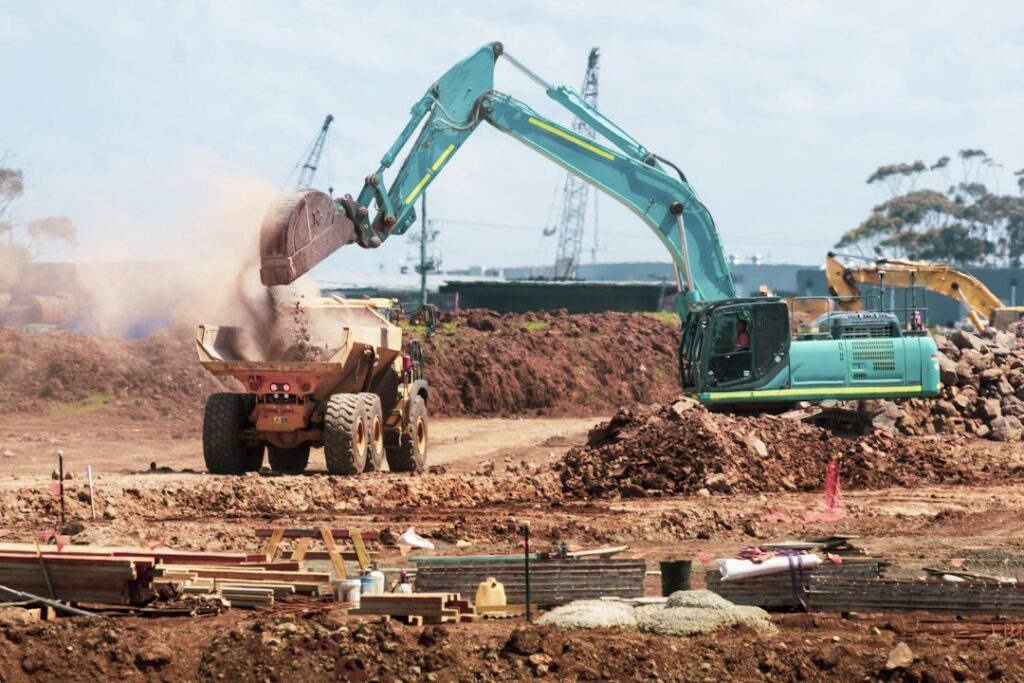
Featured photo: earthmoving construction site by Troy Mortier / Unsplash. Illustrative only; not a photograph of a specific California grading permit or project.
CALIFORNIA58 | BUILDING & LAND DEVELOPMENT | OCTOBER 18, 2026. Buying an inexpensive hillside or desert lot may be only the first expense. Owners who plan to level a building pad, cut a driveway, fill a low area or excavate for a foundation need to ask whether a grading permit and engineered plans are required before earthmoving begins. The rules depend on the jurisdiction and the scope of work.
What counts as grading?
Grading generally involves excavation, cutting, filling, moving or compacting soil. Even work that looks modest on a large rural property can redirect runoff toward neighbors or a public road. Retaining walls, drainage facilities and slope stabilization may trigger separate engineering and permit reviews. There is no single statewide exemption that makes all small grading jobs permit-free.
Start with the city or county that regulates your parcel
For a parcel inside city limits, contact the city building, engineering or public works department. For unincorporated land, begin with the county. Ask for the current grading ordinance, permit thresholds, exemptions, inspection requirements and fee schedule. A mailing address alone does not determine jurisdiction. In the high desert, for example, San Bernardino County Land Use Services provides planning and building information for its unincorporated areas, while Ridgecrest’s Engineering Division provides guidance for work under the city’s jurisdiction.
Seven checks before hiring an excavator
- Identify the parcel and zoning. Confirm whether the proposed use and building site are allowed.
- Ask about grading-permit thresholds. The volume of earth moved, cut-and-fill depth, slope, retaining structures and location can change the review required.
- Plan drainage. Find out where stormwater will flow after the ground is changed. Desert washes can flood even where rainfall is infrequent.
- Check erosion and stormwater obligations. Construction activities may be subject to local erosion-control rules and, for qualifying land disturbance, state construction stormwater requirements.
- Verify access. Cutting a driveway across someone else’s property or into a public right-of-way can require easement rights and separate encroachment approval.
- Investigate geologic hazards. Steep slopes, unstable fill and landslide-prone terrain may require a geotechnical investigation.
- Obtain written permit guidance. Ask whether a civil engineer, geotechnical professional or licensed contractor must prepare or perform particular work.
When does the state’s construction stormwater program matter?
The State Water Resources Control Board administers the Construction General Permit for qualifying construction activities. Coverage generally depends on disturbed acreage and whether smaller work is part of a larger common plan of development, subject to the permit’s detailed conditions. A local grading permit and state stormwater coverage are different questions; one does not automatically replace the other.
Do flood and landslide maps answer the question?
No. FEMA flood maps and California Geological Survey landslide resources are valuable screening tools, but they cannot approve a specific pad or drainage design. A site may require field investigation even if a regional map does not identify a hazard.
Costs that buyers often overlook
Budget for topographic surveys, soil testing, engineering, erosion controls, hauling or importing soil, compaction testing, culverts, retaining walls and inspections where required. These costs can exceed the purchase price of an inexpensive rural lot. Ask contractors to separate estimates for permit-ready design, earthwork, drainage and inspection-related work.
What should you do before clearing land?
Request parcel-specific written guidance from the permitting agency, gather a site plan and drainage concept, confirm road rights and seek professional advice for steep or unstable terrain. Do not assume that owning the land authorizes unrestricted grading. Read our related guides on landslide maps, flood risks and legal road access.
Official references: State Water Board construction stormwater program; California Geological Survey; FEMA Map Service Center. Permit applicability is project- and jurisdiction-specific; this is general information, not a permit determination.
USEFUL SERVICES
Useful services from our ecosystem
AFFILIATED RESOURCE
Travel smarter worldwide
OptionTripAI-powered trip planning for journeys in California and around the world.
Explore OptionTrip →AFFILIATED RESOURCE
Free tax & property tools
TaxesTimeFree preliminary tax and property tools, including the Property Tax Savings Report.
Explore TaxesTime →AFFILIATED RESOURCE
California document support
LegalDocSVCDocument preparation support for self-represented Californians. Not a law firm and not legal advice.
Explore LegalDocSVC →WORK WITH CALIFORNIA58
Have a story, project or partnership idea?
California58 welcomes news tips, interviews, video projects, community partnerships, advertising and other California-focused collaborations.
Work with California58 →
COMMUNITY
Comments
Join the California58 conversation. You must be signed in to comment.
Create a free California58 account or sign in with an available social provider.