
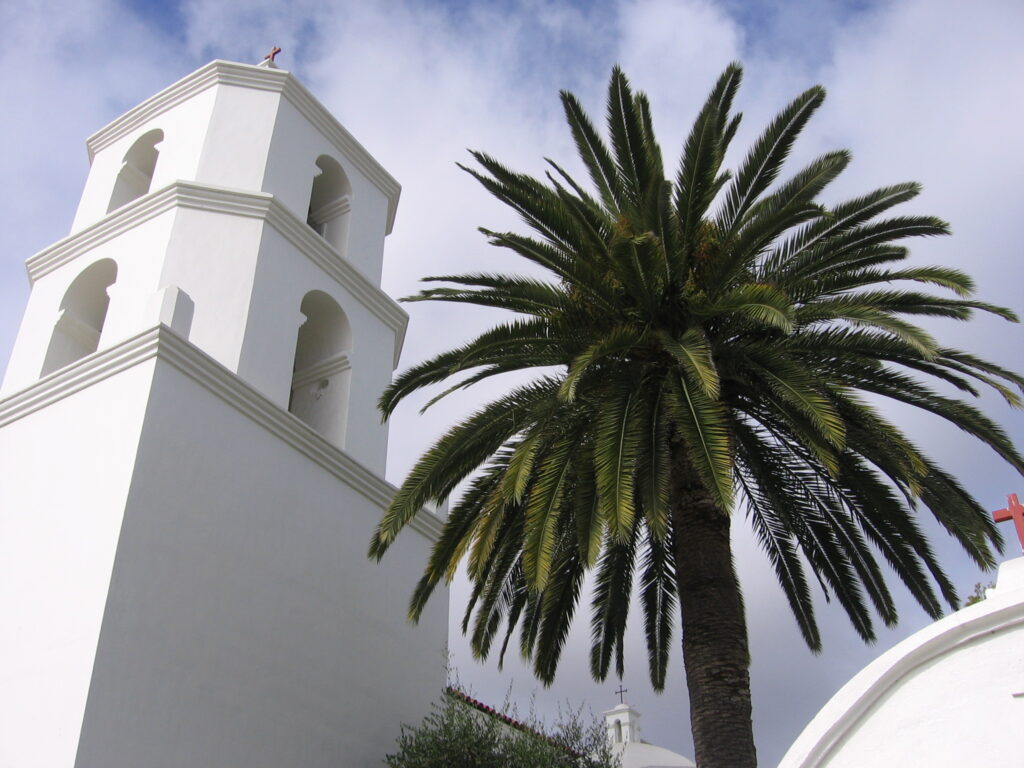
California58 Missions Trail · Mission 18 of 21 · Established 1798 · San Diego County. Explore the history, what survives today and how to plan a thoughtful visit to this part of California’s colonial past.
The history behind Mission San Luis Rey de Francia
Founded in 1798, San Luis Rey de Francia grew into one of the largest missions in Alta California. Its nickname, King of the Missions, reflects the enormous scale of its agricultural production and population. The site is now an active Franciscan mission and popular North County San Diego heritage destination.
Architecture, survival and restoration
The surviving church dates to the early nineteenth century and contains a striking interior and dome. Museums, grounds and historic remains explain the compound’s reach far beyond a single church building. Some elements are later restorations, and visitor displays make a useful companion to reading original records and preservation histories.
The people and stories beyond the mission walls
The institution operated on the homeland of the Luiseño/Payómkawichum people. Its large agricultural economy depended heavily on Indigenous labor under the colonial mission regime. Visitors should explore the history of these communities as living peoples rather than treating them as a vanished part of a tourist attraction.
The California mission system was part of Spanish and later Mexican colonization. Native communities had long histories before missionaries arrived, and many suffered under forced labor, movement restrictions, epidemics and the loss of land. Present-day descendants continue their cultures. Architecture and Catholic practice are only parts of this history; interpretation should also acknowledge Indigenous survival, resistance and perspectives.
How to visit San Luis Rey de Francia
Destination: 4050 Mission Avenue, Oceanside, CA 92057. County: San Diego. Founded: 1798.
The official museum lists admission and offers a self-guided mobile tour, while worship and cemetery access follow different rules. In the San Diego County segment of the trail, combine Oceanside with Mission San Diego de Alcalá.
Get directions to this historic site. Opening hours, visitor fees, guided-tour schedules, religious-service access and accessibility may change; always verify with the current property operator.
The ataaxam before 1798: the living Indigenous history of the valley
Today’s San Luis Rey Valley was home long before the Franciscan mission was founded in 1798. The San Luis Rey Band of Mission Indians explains that its ancestors identify as ataaxam and have lived in the river valley, coastal lagoons, oak forests, meadows and nearby creeks since time immemorial. The name “Luiseño” was assigned under the mission system; it should not displace the names people use for themselves.
The tribe describes the consequences of colonial rule as including forced labor, disease, relocation and the loss of customary life. Mission San Luis Rey was not simply a farm or monastery admired for its scale; the colonial agricultural system altered the lives and lands of Native communities. Visitors seeking a serious understanding of the landmark should read the tribal account before visiting and recognize Native residents and descendants as living members of California society.
The scale of the King of the Missions — and who worked there
The National Park Service reports that the mission came to hold vast land areas and tens of thousands of livestock, with more than 3,000 Indigenous people living at the mission at its peak. Farming and cattle operations relied heavily on Indigenous work under unequal colonial rules. The nickname “King of the Missions” is best read as evidence of the institution’s reach, not as proof of prosperity shared equally by everyone.
Architectural details tell another story. The early nineteenth-century church combines Baroque and Classical features, and its octagonal dome is unusual within the chain. The National Park Service describes how the tower once held eight bells, with fewer remaining today, and how roof and dome elements changed through restoration. Look closely at the architecture, but remember that twentieth-century preservation and rebuilding are part of what the visitor sees today.
Oceanside museum hours, costs and accessibility notes
Official posted information checked October 20, 2026: according to Mission San Luis Rey’s own museum page, museum hours are 10 a.m. to 4 p.m. daily, subject to listed holiday closures. Posted admission is $8 for adults, $5 for seniors, $5 for children ages 6–18 and free for children ages 5 and under. Active-duty military and their dependents are listed as free, and the Museums for All rate with qualifying SNAP/EBT is $3. An optional audio tour is listed at $3. Prices and schedules can change, so consult the official website before making a trip.
The mission promotes a free mobile self-guided tour covering eight stops; museum admission remains separate. Its trip-planning page warns that paths can be uneven, and photography, food and pet restrictions apply in parts of the complex. The museum, church, cemetery and parish are different spaces with different opening practices. The visitor address is 4050 Mission Avenue, Oceanside.
Make it a two-mission San Diego County day trip
The San Diego County part of the 21-mission trail has two main stops: San Diego de Alcalá in Mission Valley and San Luis Rey in Oceanside. A one-day itinerary can cover both if admission, traffic, travel time and scheduled worship allow, though exploring Indigenous history and nearby cultural sites may justify two days. Start with the San Diego de Alcalá guide, use the California58 Missions interactive map to compare locations, and check each site’s own current calendar before departing.
Featured photograph: kludgebox / Wikimedia Commons, CC BY 2.0. Display sizes may be resized or cropped by WordPress.
Original sources and useful links
- California Missions Foundation: historical overview of Mission San Luis Rey de Francia
- Official historic-site operator and visitor information
- California State Parks: mission chronology
Read this mission guide in Russian: Читать подробную статью о миссии на RusCali.com →
Continue the 21-mission journey
Explore all 21 historic California missions · Read the statewide historical guide · California58 travel resources.
Support local history reporting: Support California58 independent journalism.
Support independent journalism for all Californians
Support reporting, public information and community coverage across California’s 58 counties.
Donate once by card ↗Support California58
Choose how to support California58:
Credit / Debit Card via StripeChoose an amount from $1. One-time support through the publisher's LINKERNO Stripe account.
Continue with PayPal Continue with ZelleZelle payments go to Vitaly Ataev Troshin. Please verify the recipient in your bank before sending. Availability depends on your bank.
Optional reader support. Contributions are not advertised as tax-deductible. Support does not influence editorial decisions.USEFUL SERVICES
Useful services from our ecosystem
AFFILIATED RESOURCE
Travel smarter worldwide
OptionTripAI-powered trip planning for journeys in California and around the world.
Explore OptionTrip →AFFILIATED RESOURCE
Free tax & property tools
TaxesTimeFree preliminary tax and property tools, including the Property Tax Savings Report.
Explore TaxesTime →AFFILIATED RESOURCE
California document support
LegalDocSVCDocument preparation support for self-represented Californians. Not a law firm and not legal advice.
Explore LegalDocSVC →WORK WITH CALIFORNIA58
Have a story, project or partnership idea?
California58 welcomes news tips, interviews, video projects, community partnerships, advertising and other California-focused collaborations.
Work with California58 →
COMMUNITY
Comments
Join the California58 conversation. You must be signed in to comment.
Create a free California58 account or sign in with an available social provider.