
CALIFORNIA58 RURAL WATER INVESTIGATION | October 17, 2026. An inexpensive rural lot with no city water connection can bring a five-figure surprise: the cost of drilling, equipping and legally operating a private drinking-water well. Homeowners ask two questions before they buy: How much might a well cost—and will the county allow it?
The short answer is that private industry estimates for a completed residential well in California often start around $15,000 and can reach $45,000–$50,000 or substantially more. That is a broad planning range, not a state fee schedule, a verified statewide median or a quote for any parcel. Depth, geology, water availability and infrastructure can push a project well beyond it. There is no guarantee that drilling will find water with sufficient yield or suitable quality.
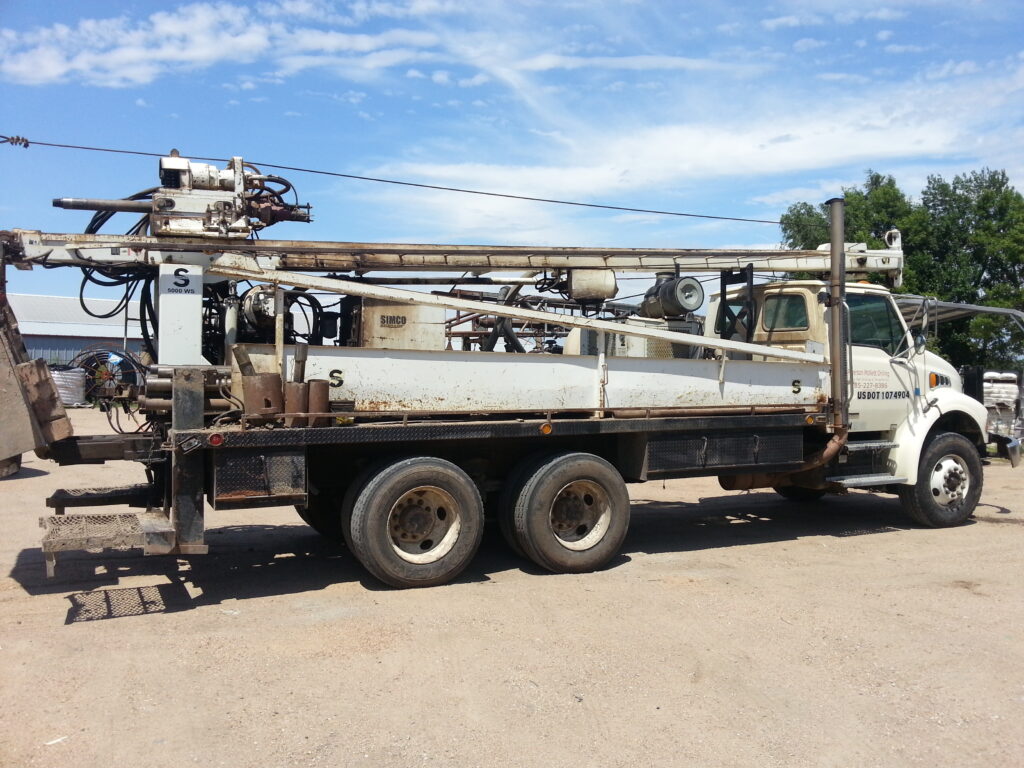
Cover photo: Water well drilling rig, an illustrative image not documented as a California job site. Photo: Mcfly05 / Wikimedia Commons, CC BY-SA 4.0; image may be displayed in responsive crops.

1. What is actually being built?
In everyday speech, a “well” might mean a traditional hand-dug well or a drilled domestic groundwater well. This report focuses on modern drilled domestic water wells supplying a home; stormwater dry wells, wastewater leach systems, agricultural production wells and oil/gas wells have different purposes and rules.
According to the California Department of Water Resources (DWR), a private-water-well project generally involves a local permit, a licensed driller, proper construction and sealing, and equipment to pump and distribute the water. State well standards form a baseline, while local enforcing agencies may impose more stringent rules.
2. Planning ranges: why estimates vary
Published commercial estimates provide a rough starting point, not an official government cost. A California driller’s 2026 guide cites approximately $15,000–$50,000+ for complete residential projects in Southern California depending on depth and conditions; an independent well-data service places many California private-well projects in an approximately $15,000–$45,000 range. Neither source proves the true total for your property.
Sources: Southern California Well Service 2026 pricing guide (commercial estimate); DrillerDB California well cost guide (commercial estimate).
| Item | What affects the bill | What to request in writing |
|---|---|---|
| Site assessment / geology | Nearby well depths, expected yield, rock and groundwater conditions | Scope of hydrogeologic review, existing DWR logs used |
| Drilling and casing | Depth, diameter, hard rock, unstable formations, sealing | Price per foot, included casing and grout, extra-depth rate |
| Pump and pressure system | Depth to water, required flow, storage, pressure tank | Pump sizing, warranty, labor and controls included |
| Electrical and piping | Power availability, trench length, panel and piping runs | Length included, transformer/meter assumptions |
| Water testing / treatment | Local contaminants, testing panel, filters or treatment | Accredited laboratory costs, recommended tests and system |
| County permits / inspections | Local fee schedule, agency inspections and any special review | Official permit fee and current county requirements |
| Contingency | Dry hole, insufficient yield, deeper drilling or redesign | Written stop-work and failed-well payment terms |
Illustrative arithmetic, not a price quote: At an assumed drilling-only rate of $35–$85 per foot, 200 feet would mean $7,000–$17,000 before some or all of the casing, pump, electrical, permits, testing, treatment and other work. A 400-foot hole at that same hypothetical rate would be $14,000–$34,000 for the rate-based portion alone. Confirm what a local bid includes: different companies bundle different components, so line items should not be added twice.
3. County permit costs can differ significantly
There is no single statewide county permit price. DWR explains that cities, counties and other local agencies may serve as the enforcing agency for well permits. The county’s published fee schedule—and sometimes a local water agency’s requirements—must be checked for the exact parcel.
California’s State Water Resources Control Board published a 2024 drinking-water cost-model appendix with county-level modeled well-permitting cost assumptions. Examples included Modoc $90, Mariposa $248, Riverside $719, San Bernardino $906, Kern $2,320 and Los Angeles $3,209. These are 2024 modeling inputs—not verified current 2026 permit invoices or an all-in well cost. The appendix covers a different modeling purpose and must not be mistaken for a quote for a private domestic well today. See the 2024 State Water Board cost-model appendix.
For a more recent direct example, San Diego County’s well-fee table lists an approved FY 2026–27 domestic well permit fee of $1,751. Permit fees can change and the fee may not include other project services. This is one county’s published fee, not a statewide benchmark.
Kern County’s checklist shows why a drilling permit is not automatic
Kern County Public Health’s official well site-plan requirements call for property lines, easements, any existing wells, nearby buildings, drainage features and separation distances from septic tanks, leach fields, storm drains and sewer lines—including facilities on adjacent parcels. Inspectors review siting, potential pollution, flooding, future access and replacement septic areas. A small parcel can have too little usable space for the well-and-septic configuration a homeowner imagined, even if drilling equipment can physically reach the land.
For an initial groundwater investigation, use the California DWR Well Completion Reports map to identify nearby documented wells and inspect available depth, construction and yield information. DWR warns that well-report data can have missing or inaccurate information and limited location precision. Nearby depth is evidence for questions to ask a licensed driller, not a promise of water on a neighboring property.
4. San Bernardino County: one specific rule readers can verify
For readers in the Mojave Desert, including unincorporated communities in San Bernardino County, county Environmental Health Services says a permit is required to construct, rehabilitate or destroy a well. Its FAQ says the permit must be signed by the owner and a C-57 driller registered with that county. This is especially relevant for proposed housing outside a public water district’s service area. Read the county’s well permit FAQ or water-well resources. Do not assume permits can be obtained retrospectively after drilling.
5. Can homeowners drill their own well?
No, not under the ordinary California owner-builder exception. CSLB explicitly excludes well-drilling work classified as C-57 from work an unlicensed property owner may perform. DWR likewise states that well construction must be undertaken by an appropriate licensed C-57 contractor. Pump work may involve a C-57 or an appropriately licensed C-61/D-21 contractor, according to DWR.
Sources: CSLB owner-builder overview; DWR water-well basics.
6. Water availability is different from permission to drill
Obtaining a permit does not guarantee adequate groundwater, a productive aquifer, legal extraction capacity or safe drinking water. California’s Sustainable Groundwater Management Act (SGMA) directs long-term groundwater planning in covered basins through local groundwater sustainability agencies. Depending on the parcel, local ordinances, basin rules, neighboring wells and water-quality concerns may affect the application. SGMA is not a blanket statewide prohibition on all domestic wells; ask the responsible local enforcing agency and groundwater sustainability agency about current site-specific conditions.
DWR’s March 2026 Bulletin 118 update highlights the continuing importance of groundwater monitoring and local basin management. DWR’s Well Completion Reports map can help a prospective landowner research nearby documented well depths and conditions, although surrounding wells cannot guarantee similar yield or quality at the target parcel.
7. Well water may require testing and treatment
Private domestic well water generally is not monitored the same way as a regulated public supply. Laboratory testing is needed to evaluate microbial and chemical concerns; wells may encounter arsenic, nitrate, salts or other contaminants depending on local hydrogeology. No cost estimate is complete until someone assesses whether treatment is required. State Water Board’s Domestic Well Project provides background on chemical sampling; its historic voluntary project should not be misrepresented as a currently available free test for every owner.
For practical steps after installation, read our earlier guide: Private Wells in Rural California: How to Check Drinking Water Safety.
8. Questions to ask before signing a drilling contract
- Which local agency issues the permit for my APN, and what is the current fee?
- Are there groundwater-basin, moratorium, water-district or siting restrictions?
- Is the driller’s C-57 license active, and is county registration required?
- What do nearby DWR well-completion logs show, and how uncertain is the actual site?
- What per-foot price applies, and what work is included or excluded?
- What happens financially if water is not found or the water yield is inadequate?
- Who handles the pump, pressure tank, electric connection, sampling and inspections?
- Who submits the completion report to DWR and when?
- What sampling and possible treatment must be completed before relying on the water for drinking?
- What written warranty and maintenance schedule apply?
DWR says contractors must file a well-completion report within 60 days after completion. Before buying rural land, treat water feasibility as an essential part of property due diligence, not as a job to investigate after delivery of a house.
2026 update: California rescinded the emergency drought-related well-permitting orders
A crucial distinction for land buyers: California Department of Water Resources confirms that the added well-permitting provisions of 2022 Executive Order N-7-22 (as subsequently modified) were rescinded September 5, 2024, by Executive Order N-3-24. A 2022 or 2023 article treating those particular temporary requirements as still active in 2026 is outdated. Their rescission does not eliminate local well permits, SGMA-related management, safe-construction requirements or relevant groundwater-basin rules. Sources: DWR well-permitting policy and emergency-order history and current local agency directory.
2026 update: check rental-property well testing under AB 2454
For a property supplied by a private well and rented to tenants, California State Water Resources Control Board explains that AB 2454 creates additional testing and information duties in specific covered areas. The relevant conditions include a domestic well supplying rental property and location within a qualified free well-testing program. Covered landlords must use the free program, share results with residents within 10 days of receiving them and meet applicable safe-water obligations where the program provides appropriate replacement-water options. It is not a statewide rule that every private home well must undergo the same landlord procedure. See the agency’s AB 2454 guidance, updated June 2026. For domestic owners generally, the State Water Board recommends periodic laboratory testing; GAMA’s testing checklist lists typical basic laboratory sampling at approximately $100–$400, varying with the tests selected.
2026 update: why hauled water may not make a new house buildable
San Bernardino County’s official safe-drinking-water guidance specifically highlights California Water Code section 106.4(c), which restricts building permits for new residential development when hauled water is the proposed water supply. The county describes limited treatment for rebuilding qualifying previously approved residences after disaster damage. Do not assume a remote new manufactured home or self-built house can obtain approval by promising water-truck deliveries. Ask the planning/building department for parcel- and project-specific written requirements before purchase.
Research nearby well records before requesting quotes
Our California Well Completion Reports guide explains how to investigate available drilling records before commissioning work. Pair that research with the septic-permit and perc-test guide when reviewing a rural housing project. Records and estimates are starting points for questions, not a guarantee of a productive well or an approved building site.
9. How this changes the housing equation
A permitted manufactured home or an owner-built conventional house still needs lawful water and wastewater arrangements. A remote lot that appears cheaper may become uneconomic if drilling requires exceptional depth, if its water is unsuitable, or if there is no road and power infrastructure. Compare these two companion investigations: where manufactured homes may be placed and how California’s owner-builder process works.
California58 wants real numbers. If you have an anonymized 2025 or 2026 county well permit, contractor bid or invoice, or a written denial with a cited ordinance, send it to our newsroom. We will distinguish advertised estimates, actual permitted project costs and government fees. Support original rural-water reporting. Find your community in our local newspaper directory.
Method and disclosures: Original cross-source synthesis checked October 17, 2026. Government water-well construction and permit requirements are primary sources; consumer cost ranges are clearly identified as commercial estimates, not State Water Board official prices. The 2024 county modeling figures are historic inputs, not current fee quotes. The featured image is a general rural California landscape—not a photograph of the well or drilling site. No paid driller endorsement or unverified affiliate link appears in this report.
USEFUL SERVICES
Useful services from our ecosystem
AFFILIATED RESOURCE
Travel smarter worldwide
OptionTripAI-powered trip planning for journeys in California and around the world.
Explore OptionTrip →AFFILIATED RESOURCE
Free tax & property tools
TaxesTimeFree preliminary tax and property tools, including the Property Tax Savings Report.
Explore TaxesTime →AFFILIATED RESOURCE
California document support
LegalDocSVCDocument preparation support for self-represented Californians. Not a law firm and not legal advice.
Explore LegalDocSVC →WORK WITH CALIFORNIA58
Have a story, project or partnership idea?
California58 welcomes news tips, interviews, video projects, community partnerships, advertising and other California-focused collaborations.
Work with California58 →
COMMUNITY
Comments
Join the California58 conversation. You must be signed in to comment.
Create a free California58 account or sign in with an available social provider.