
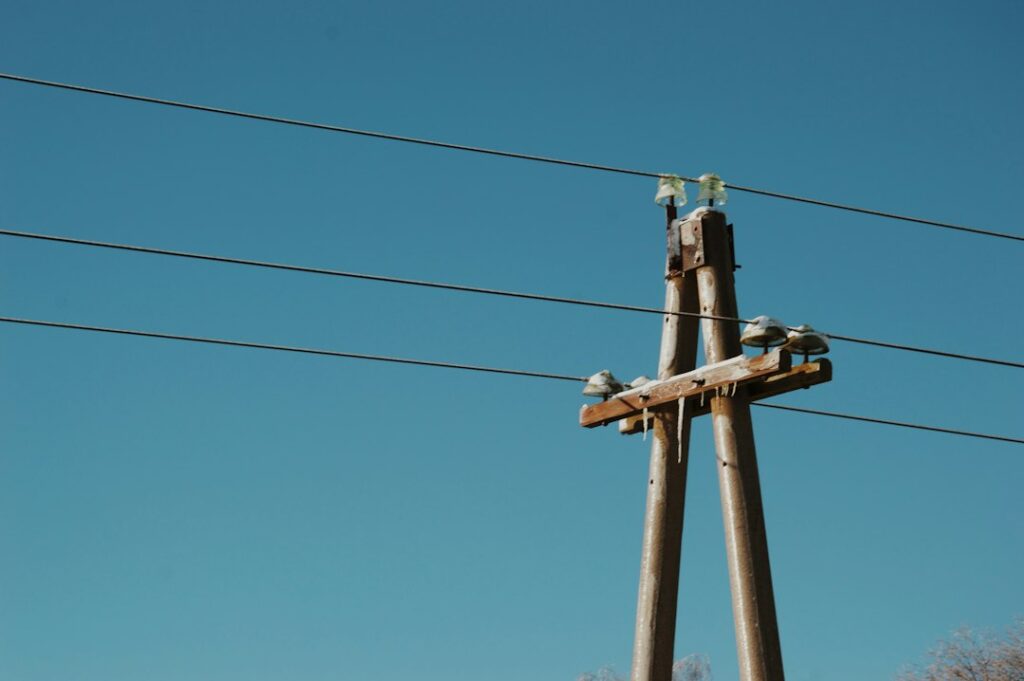
CALIFORNIA58 LAND & HOUSING INVESTIGATION | October 17, 2026. A cheap California parcel may sit within sight of power lines and still require substantial work before a house receives electricity. The mistake is assuming that a nearby pole establishes the right, capacity or price of a new connection. It does not. The electric utility must identify the available system, design the service route and determine the work needed at that specific address or Assessor’s Parcel Number (APN).
There is no reliable statewide flat price per foot that California58 can apply to every rural lot. Soil, distance, easements, underground construction, transformer capacity, meters, grading, permits and customer-provided trenching can change a quote dramatically. This guide complements our 17-point rural-land due diligence checklist, private-well investigation and owner-builder permit guide.
1. Find out which utility actually serves your property
Large investor-owned utilities include Pacific Gas and Electric (PG&E), Southern California Edison (SCE) and San Diego Gas & Electric (SDG&E). Other areas are served by municipal utilities, irrigation districts or electric cooperatives. A property’s mailing city does not necessarily identify its power supplier. Ask the utility directly whether the APN is in its service territory and whether service is available.
2. The two California tariff rules every buyer should know
The California Public Utilities Commission (CPUC) describes Rule 15 and Rule 16 for investor-owned electric utilities. Rule 15 concerns distribution-line extensions from the existing utility distribution network; Rule 16 concerns service-line extensions linking distribution facilities to customer metering. Both can affect a project, although some lots require only one type of work.
CPUC guidance describes underground-construction requirements and exceptions under these tariffs. Do not infer that any overhead line can simply be extended to a new rural house on demand; have the utility determine the applicable rule, design and payment obligations.
3. What might appear on the real estimate?
A complete project budget can include the utility’s design work; distribution or service extensions; poles or conduit and trenching; a new transformer or equipment upgrade; meters; an electrical panel and connection equipment; inspection; permitting; traffic control; private-road restoration; easement acquisition; and work performed by licensed contractors on the owner’s side of the service point. Ask which items are included in the utility’s price and which are separately paid to third parties.
Distance alone is not a price formula. A short extension with a road crossing or transformer upgrade can cost more than a longer, technically simple route. A property several miles from usable infrastructure can be infeasible within the buyer’s budget even if the listing advertises “power nearby.”
4. New service is not the same as upgrading an existing panel
SCE’s Building and Renovation service page has distinct pathways for new residential service, subdivision service, ADUs, temporary construction power and existing panel upgrades. A program or incentive for upgrading an already electrified building is not automatically applicable to bringing a new line to a vacant parcel. Ask specifically about new permanent residential service to undeveloped land.
5. Start the formal utility request early
PG&E provides a building project resource center and its 2026 Electric and Gas Service Requirements Greenbook. SCE provides a Building, Renovation and Project Planning Portal and current Electrical Service Requirements. Request a project or service-request number so follow-up questions can be tied to the same location.
Utilities may request site plans, load calculations, photographs, maps, property information and signed agreements. A quote obtained without clear home and meter locations may need revision when actual engineering begins.
6. Who owns the route to the proposed meter?
The straight line from a pole to a house may cross a neighbor’s property, an unrecorded dirt road, a utility easement or public right-of-way. Confirm legal access to construct and maintain the infrastructure. A visible dirt road is not proof of a utility easement. Ask whether the utility or landowner must obtain recorded easements, county encroachment permits, environmental approvals or access rights.
7. Allow time for design, permits and construction
The utility connection process is not necessarily a same-week job. SCE describes several stages of energization, including intake, engineering, customer dependencies, third-party permissions, readiness checks, construction and meter energization. Published utility targets cover specified utility-controlled steps and do not eliminate delays attributable to the applicant’s documents or permits. Do not schedule a move-in date from an unapproved estimate.
8. Could solar and battery storage be a cheaper alternative?
In some remote places, an engineered standalone solar-plus-battery system may be worth comparing with grid extension. But the alternative still requires safe electrical design, appropriate permits, dependable year-round performance and lawful occupancy. It does not remove zoning, plumbing or wastewater requirements. Read our companion off-grid home permitting and systems guide before assuming a battery makes the development “permit-free.”
9. Questions to send the utility before closing
- Does your utility serve the parcel identified by this APN, and where is the nearest usable distribution point?
- Will the project involve Rule 15, Rule 16, both or different tariffs for a publicly owned utility?
- What plans, load estimates and drawings are needed for a preliminary assessment?
- Who builds and pays for trenching, conduit, transformer work, panels and permits?
- Does the extension require new easements, rights-of-way or off-parcel construction?
- What is the current process for an itemized design-based estimate, and when can pricing change?
- Are there capacity limitations, line-extension conditions, deposits, credits or refunds that apply to this specific project?
- What must be inspected before the meter can be energized?
What California buyers should do next
Identify the parcel, its legal building path and intended electrical load before treating the land as buildable. Gather estimates for roads, septic feasibility, water supply and the electric extension in one project budget. If any one system cannot be legally installed, a low purchase price does not rescue the plan.
Official references
- CPUC — Electric Rules 15 and 16
- PG&E — Building Project Resources and Greenbook
- SCE — New Service Connection Requests
- SCE — Electrical Service Requirements
Editorial note: October 17, 2026. California58 makes no universal per-foot cost claim. An actual project estimate must come from the serving utility and qualified contractors.
USEFUL SERVICES
Useful services from our ecosystem
AFFILIATED RESOURCE
Travel smarter worldwide
OptionTripAI-powered trip planning for journeys in California and around the world.
Explore OptionTrip →AFFILIATED RESOURCE
Free tax & property tools
TaxesTimeFree preliminary tax and property tools, including the Property Tax Savings Report.
Explore TaxesTime →AFFILIATED RESOURCE
California document support
LegalDocSVCDocument preparation support for self-represented Californians. Not a law firm and not legal advice.
Explore LegalDocSVC →WORK WITH CALIFORNIA58
Have a story, project or partnership idea?
California58 welcomes news tips, interviews, video projects, community partnerships, advertising and other California-focused collaborations.
Work with California58 →
COMMUNITY
Comments
Join the California58 conversation. You must be signed in to comment.
Create a free California58 account or sign in with an available social provider.