
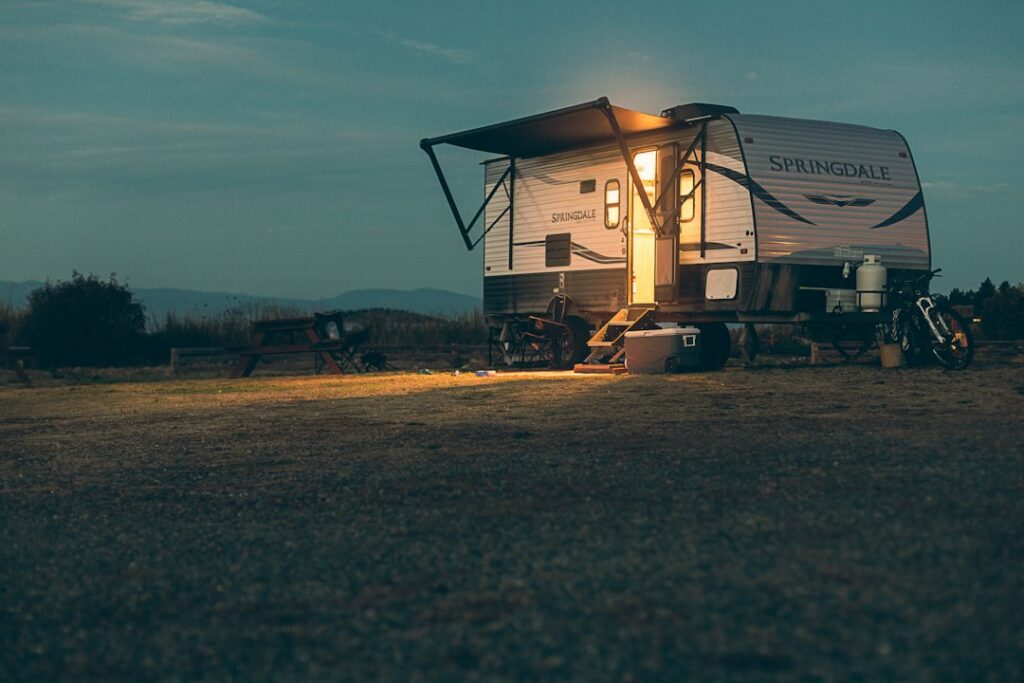
CALIFORNIA58 PROPERTY RIGHTS & LAND USE | October 17, 2026. A common California land-shopping pitch goes like this: buy five acres in the desert, park a travel trailer, add solar panels and avoid the cost of a conventional house. The missing sentence is the most important one: owning land does not by itself establish the right to live in an RV there year-round. Whether that use is allowed depends on the parcel’s land-use jurisdiction, the proposed occupancy and applicable rules for camping, vehicles, sewage, water and fire safety.
California58’s 17-point land-purchase investigation explains why “residential zoning” is not the same as permission for every structure or use. This guide focuses on a narrower and frequently misunderstood question: when can a motorhome or travel trailer be occupied on private property?
Is there one California law allowing RV residence on all private land?
No statewide rule identified by California58 gives every landowner blanket permission to turn vacant property into a permanent RV residence. Local zoning and land-use controls matter, and some areas allow particular temporary uses or make special provisions for designated facilities. Do not rely on a seller’s guarantee of “unrestricted land” unless a current written agency determination supports that specific proposed use.
State regulation also distinguishes approved mobilehome parks and special occupancy parks. The California Department of Housing and Community Development (HCD) describes a special occupancy park as a category of facility that can include multiple RVs or camping lots held out for rent or lease. This is not a rule that transforms a single privately owned empty lot into an approved RV park. Approved parks operate within a separate legal framework.
Why the zoning label can mislead you
“Rural residential,” “agricultural,” “desert” and other labels describe zoning districts, not necessarily every allowed use. The county or city’s published zoning code must be read together with overlays, camping rules and building requirements. A small building, manufactured house, tiny house on wheels, RV and travel trailer may receive different treatment. Some rules differ between an occupied parcel containing a permitted house and an undeveloped vacant parcel.
A postal city name may not tell you who issues land-use approvals. The important question is whether the parcel falls inside incorporated city limits or in unincorporated county territory. Use the APN and a county GIS map to locate the correct authority.
What if I live in my trailer while constructing a house?
Some owners hope to occupy an RV temporarily while a permitted home is built. Do not assume this is automatically permitted. Ask whether a temporary occupancy or construction-related permit exists, when it may be issued, how long it lasts, what project milestones it requires, and how potable water and sewage must be handled. The absence of a building on the land can matter. Record the answer, ordinance citation and any permit conditions before buying or moving an RV onto the site.
Can I park it without living in it?
Storage and parking are not identical to residential occupancy, and local rules can regulate parking surfaces, setbacks, nuisance conditions and vehicle status. A parcel that permits RV storage may not permit overnight residence. Conversely, a place that permits limited camping may set rules that do not apply to permanent residence. Ask separately about parking, camping, occupancy and connections to utilities.
RVs are not the same as permanent manufactured homes
HCD and California law distinguish several categories of homes and vehicles. In discussing park residents, HCD describes recreational vehicles, park trailers and manufactured homes under different sets of rules. The department’s park laws and regulations address designated facilities. If your goal is a year-round home on your own land, compare a properly installed manufactured home using our manufactured-home county guide and our tiny-house classification guide rather than assuming an RV enjoys the same rights.
Water and sewage remain real problems
Full-time RV use needs a lawful sanitation plan. Dumping wastewater on the ground is not a permitted substitute for disposal, and a portable tank does not create blanket zoning permission. Ask the relevant Environmental Health agency what facilities are required and whether your proposed arrangements are allowed for the particular use. California’s State Water Board regulates onsite wastewater treatment systems, commonly called septic systems; permits are generally handled by authorized local agencies.
Even where a temporary RV use is potentially allowed, a building project may need separate proof of a dependable potable water source. Our well drilling guide covers the water-supply challenges affecting rural lots; our septic permit and perc-test report explains the wastewater side. Solar panels, batteries and hauled water do not exempt a project from all health and land-use requirements.
Fire danger, access and flood channels
An RV may be especially exposed to wildfire, storms and access limitations. Check the parcel with CAL FIRE’s Fire Hazard Severity Zone resources, plus local emergency access rules and floodplain information. Desert washes can flood even when surrounding land is normally dry. Insurance coverage and campground-style liability issues should be reviewed independently.
A due-diligence checklist for buyers
- Obtain the APN and confirm legal ownership, access and city-versus-county jurisdiction.
- Define your exact activity: storage, weekends of camping, seasonal occupancy or full-time residence.
- Give the planning department the proposed RV type, number of occupants, site layout and proposed duration.
- Request the controlling ordinance and whether the use is allowed outright, needs a discretionary approval, needs a temporary permit or is prohibited.
- Ask about active construction if you intend to live there while building a permitted residence.
- Resolve waste and water with Environmental Health; confirm any dumping, storage, connection and discharge requirements.
- Check practical costs for access, grading, electricity, emergency services, insurance and potential removal requirements.
- Use a suitable purchase contingency and do not rely on verbal assurances where lawful RV occupancy is essential to your plan.
A sample email you can copy
I am considering purchasing APN [number], located at [location]. I propose to place [RV type] on the parcel and occupy it [full time / weekends / during permitted home construction] for approximately [duration]. Is this use permitted under the current zoning and camping ordinances? Please identify the relevant code sections, any required permits, maximum duration, water and wastewater requirements, and whether the answer differs if the parcel is vacant or has an existing lawful dwelling. Thank you.
Bottom line: do not buy “RV-friendly” land on a slogan
There may be lawful options for seasonal use, approved parks or specific local temporary permits. But those possibilities do not establish a general right to occupy any California lot as a permanent RV address. Get a documented county or city answer tied to the APN and intended use before you buy or relocate.
Primary sources
- California HCD — What Is a Mobilehome Park or Special Occupancy Park?
- California HCD — Park Laws and Regulations
- California HCD — Permit to Operate for Parks
- California State Water Board — Wastewater and Septic Policy
- CAL FIRE — Fire Hazard Severity Zones
Editorial note: California58 reports statewide principles and authoritative agency references. It has not issued an approval, identified a universally legal RV county, or verified any individual parcel for long-term RV occupancy.
USEFUL SERVICES
Useful services from our ecosystem
AFFILIATED RESOURCE
Travel smarter worldwide
OptionTripAI-powered trip planning for journeys in California and around the world.
Explore OptionTrip →AFFILIATED RESOURCE
Free tax & property tools
TaxesTimeFree preliminary tax and property tools, including the Property Tax Savings Report.
Explore TaxesTime →AFFILIATED RESOURCE
California document support
LegalDocSVCDocument preparation support for self-represented Californians. Not a law firm and not legal advice.
Explore LegalDocSVC →WORK WITH CALIFORNIA58
Have a story, project or partnership idea?
California58 welcomes news tips, interviews, video projects, community partnerships, advertising and other California-focused collaborations.
Work with California58 →
COMMUNITY
Comments
Join the California58 conversation. You must be signed in to comment.
Create a free California58 account or sign in with an available social provider.