
CALIFORNIA58 HOUSING INVESTIGATION | October 17, 2026. Can you buy a plot in rural California, build a small home with your own hands and avoid paying a general contractor? Sometimes, yes. But the state’s owner-builder exemption is not an exemption from building codes, inspections, zoning restrictions, wastewater standards or the cost of utility connections. And no county can simply waive statewide construction standards for a regular permanent residence.
The practical question is not only which county is easiest but which property can actually support the house you plan to build, with an achievable permit pathway and a realistic budget.
1. California does allow owner-builders
The Contractors State License Board (CSLB) explains that the owner of property may qualify as an owner-builder without holding a contractor license in certain circumstances: performing work personally or through employees under applicable conditions, or contracting with properly licensed tradespeople. Separate restrictions apply when homes are constructed for resale. The property owner remains responsible for the project and applicable labor and safety obligations.
CSLB’s official owner-builder overview explains the exceptions and limitations. California does not permit a person to use the owner-builder exemption to personally conduct licensed C-57 well drilling. Anyone advertising that the owner-builder exemption eliminates all licensed-trade requirements should be asked for a supporting legal provision.
2. What does an owner-builder still have to do?
Generally, a new house requires a legally buildable parcel, zoning clearance, approved construction documents, a building permit, inspections and final occupancy authorization. Engineering and specialist designs may be required based on the project, not merely because the owner lacks a contractor license. The following issues should be priced before closing on the land:
- Access: recorded road easement, driveway and emergency vehicle access, and possible road improvements.
- Power: utility feasibility, new service, trenching, pole or transformer upgrades.
- Water: a documented legal supply, meter availability or a permitted well; drilling can be a substantial separate construction project.
- Wastewater: sanitary sewer hookup or a locally permitted septic system; difficult soils or setbacks may defeat an otherwise appealing parcel.
- Site: geotechnical/soils studies when required, slopes, retaining walls, grading, floodplain rules and drainage.
- Safety: wildfire-resistant construction or defensible-space rules where applicable, seismic design and inspections.
- Fees: application and plan-review charges, school or impact fees where applicable, utility connection charges, and possible fire and road requirements.
3. New homes in 2026: the code cycle matters
California’s 2025 Energy Code took effect January 1, 2026, according to the California Energy Commission. This code influences energy-design documents, insulation, building systems and compliance review. Review the official January 2026 Energy Commission explanation and code resources before purchasing a predesigned home plan.
Wildland construction requirements can also affect windows, vents, roofs, exterior walls and site work. Check the CAL FIRE hazard-zone map and wildland construction guidance for the address. The building department must clarify which code edition applies to your particular permit application and any local amendments.
4. What county paperwork tells us
| Jurisdiction example | Confirmed public information | What is not proven |
|---|---|---|
| Sacramento County, unincorporated | Its building division publishes an owner-builder acknowledgment, AP-16, covering responsibility for construction and workers. It also publishes an agent authorization form, AP-17, and an online permit tutorial. | These resources do not establish that approval is faster or cheaper than in another county. |
| San Bernardino County, unincorporated | Land Use Services identifies rural and residential land-use districts and provides guidance on site-specific manufactured-home permissions. This illustrates why checking a particular parcel’s district matters before choosing a construction method. | Rural zoning does not automatically grant permission to build any size or style of home without review. |
| Los Angeles County, unincorporated | County Planning publishes detailed land-use FAQs; applications and requirements vary significantly by zone and planning area. | No apples-to-apples owner-builder approval-time or all-in cost comparison has been verified against the other counties. |
Primary resources: Sacramento County Building Permits & Inspection; Sacramento owner-builder acknowledgment (PDF); San Bernardino Land Use Services guidance; Los Angeles County Planning FAQs.
A measurable county example: Kern’s residential permit fee estimator
Kern County publishes a residential building fee estimator and explanation for new dwellings. Its FAQ warns that entering zero for an unknown item omits that fee from the estimate, and actual fees may increase after the county learns the full project requirements. The tool is useful for documenting a transparent preliminary permit budget, not for proving Kern is the cheapest county.
To compare counties fairly, use the same proposed one-story home, square footage and unincorporated-parcel scenario, then record the current building permit, plan-check, school/impact and other agency charges separately. A quote from one county for a fully serviced lot cannot be compared with a quote from another for raw land without accounting for well or water connection, septic, legal access and utility extensions. Also check the CSLB’s owner-builder responsibility guidance: the exemption does not eliminate the owner’s obligations for code-compliant work or inspections.
5. The cost of doing it yourself: where the savings disappear
Reducing contractor overhead or doing some labor can save money, but it also transfers scheduling, insurance, procurement, coordination and quality-control responsibility to the owner. An owner-builder must account for plan production, permit fees, inspection corrections, subcontractor work, weather delays, material loss and necessary contingencies.
We are not publishing a universal dollar-per-square-foot estimate for every California county: land prices, utility extension distances, foundation conditions and permitted designs can differ dramatically. Instead, request three documented quotes for the same plan and lot, and separate:
- Land acquisition and transaction costs from construction.
- Soft costs (design, survey, engineering, permit/plan check, soils study).
- Site/infrastructure costs (water, sewer/septic, power, road, grading).
- Building costs (foundation, frame, roof, electrical, mechanical, plumbing, finishes).
- Risk reserve for unforeseen conditions and changes.
Do not treat the ability to obtain an owner-builder permit as evidence that it is safe to hire unlicensed crews informally. Sacramento County’s owner-builder warning specifically discusses liability for injuries and employment-related risks. The project’s legal and insurance obligations require careful review.
6. Building a small house or tiny home
Smaller floor area may reduce some material costs, but it does not automatically eliminate sewer or septic, drinking-water, fire, permit and legal-occupancy requirements. Sacramento County’s FAQ states that a movable tiny house generally cannot be used as an ordinary dwelling unless placed on an approved permanent foundation and meeting residential building codes. Recreational vehicles and trailers follow different rules. A small code-compliant residence is a different proposal from parking a trailer on undeveloped land.
7. How California58 will compare all 58 counties
A defensible comparison must apply the same hypothetical project to comparable lots. See our new 2026 four-county documented permit comparison and proposed 100-point feasibility rubric; it does not claim a verified all-58-county ranking. Our proposed benchmark: a modest one-story detached residence on a legally created unincorporated residential parcel with legal road access, paired with an explicit water and wastewater scenario. For each county the investigation needs dated responses on zoning clearance, owner-builder paperwork, plan-review steps, typical processing timelines, building and impact fees, local energy/fire amendments and availability of utilities. A separate scenario will cover mountainous or high-fire-hazard land.
Preliminary conclusion: Based on the sources reviewed, it is not responsible to label one county the easiest statewide. The most straightforward parcel may be one with documented single-family zoning, existing utilities, a paved legal access road and no extraordinary hazard or grading requirements—even if its purchase price is higher.
Checklist before buying rural land
- Get the parcel’s assessor number (APN), legal description and zoning map from the responsible county or city.
- Ask Planning in writing whether the proposed dwelling is a permitted use and whether discretionary review is needed.
- Request the complete current fee estimate from Building and Planning.
- Request written water, wastewater and electric feasibility or cost quotes.
- Check flood, wildfire, slope and environmental constraints.
- Confirm the owner-builder eligibility and required acknowledgment.
- Do not begin grading or construction until the necessary permits are issued.
Research the parcel before pricing the house
Continue with our guide to APNs, assessor maps and buildability, then review flood-map and drainage questions before buying land. For Trona-area readers, see the Searles Valley zoning and permit research guide. These companion articles help organize questions for the authority responsible for your parcel.
Follow the series
Considering a factory-built option? Read Where Can You Place a Manufactured Home in California? If a parcel needs its own drinking water, see our well-drilling costs and permits investigation. Follow community coverage in the California58 local newspaper directory.
Know the local process? Builders, homeowners and permit officials can send recent anonymized fee schedules, code citations or processing data to California58. Support independent reporting on California housing accessibility.
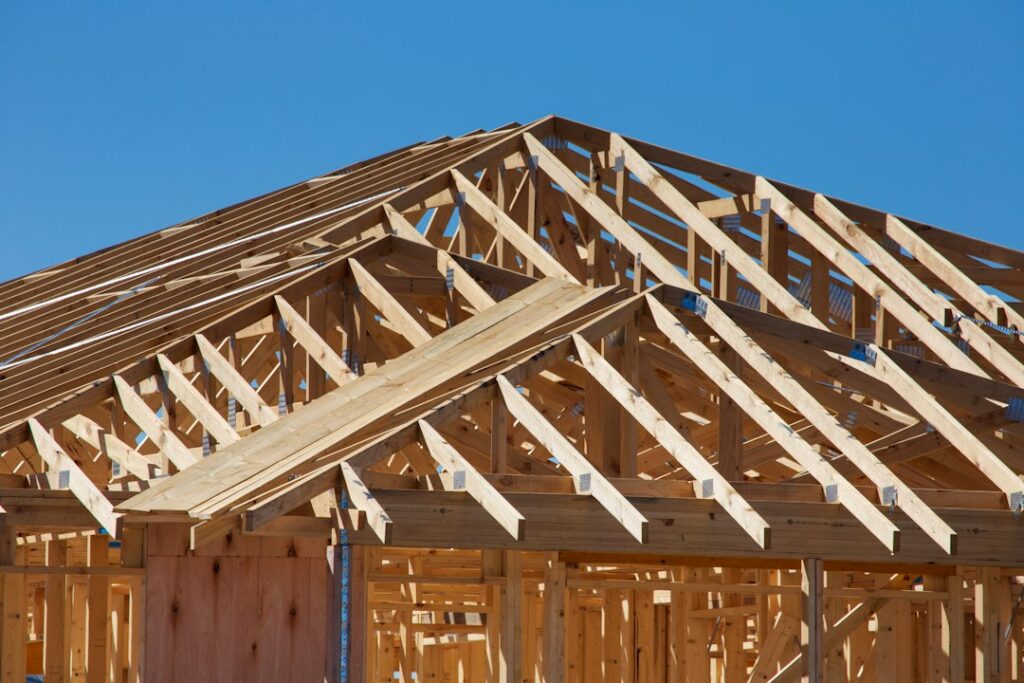
Reporting note: This article is an original comparison of public statewide and county materials, not a completed census of 58 county building departments or a legal/engineering opinion. Featured photograph: timber roof trusses at a house construction site, Troy Mortier / Unsplash. It is illustrative, not a documented California owner-builder project. Information checked October 17, 2026; permit conditions can change.
USEFUL SERVICES
Useful services from our ecosystem
AFFILIATED RESOURCE
Travel smarter worldwide
OptionTripAI-powered trip planning for journeys in California and around the world.
Explore OptionTrip →AFFILIATED RESOURCE
Free tax & property tools
TaxesTimeFree preliminary tax and property tools, including the Property Tax Savings Report.
Explore TaxesTime →AFFILIATED RESOURCE
California document support
LegalDocSVCDocument preparation support for self-represented Californians. Not a law firm and not legal advice.
Explore LegalDocSVC →WORK WITH CALIFORNIA58
Have a story, project or partnership idea?
California58 welcomes news tips, interviews, video projects, community partnerships, advertising and other California-focused collaborations.
Work with California58 →
COMMUNITY
Comments
Join the California58 conversation. You must be signed in to comment.
Create a free California58 account or sign in with an available social provider.