
California58 Mission Trail · Mission 1 of 21 · Founded 1769 · San Diego County. California’s missions are historical places and, in many cases, active religious institutions. This independent guide separates the surviving site from the colonial history that created it.
Why Mission San Diego de Alcalá matters
The first Alta California mission was founded on July 16, 1769. Its original location was near today’s Presidio Hill, overlooking San Diego Bay, not the site where visitors find the church today. In 1774 the institution moved inland, closer to the San Diego River, agricultural land and Native villages. This distinction matters: touring the present compound is not the same as standing on the original founding ground.
Architecture and what survives
The Kumeyaay people, including Tipai and Ipai communities, already occupied the region with their own languages, networks and spiritual traditions. The colonial enterprise profoundly disrupted their lives. Opposition culminated in the 1775 attack that destroyed much of the mission compound and killed missionary Luis Jayme, as well as Indigenous participants. A responsible history tour must discuss the resistance and the unequal power relations, not present the church as a structure built in an empty landscape.
Indigenous history and what visitors should remember
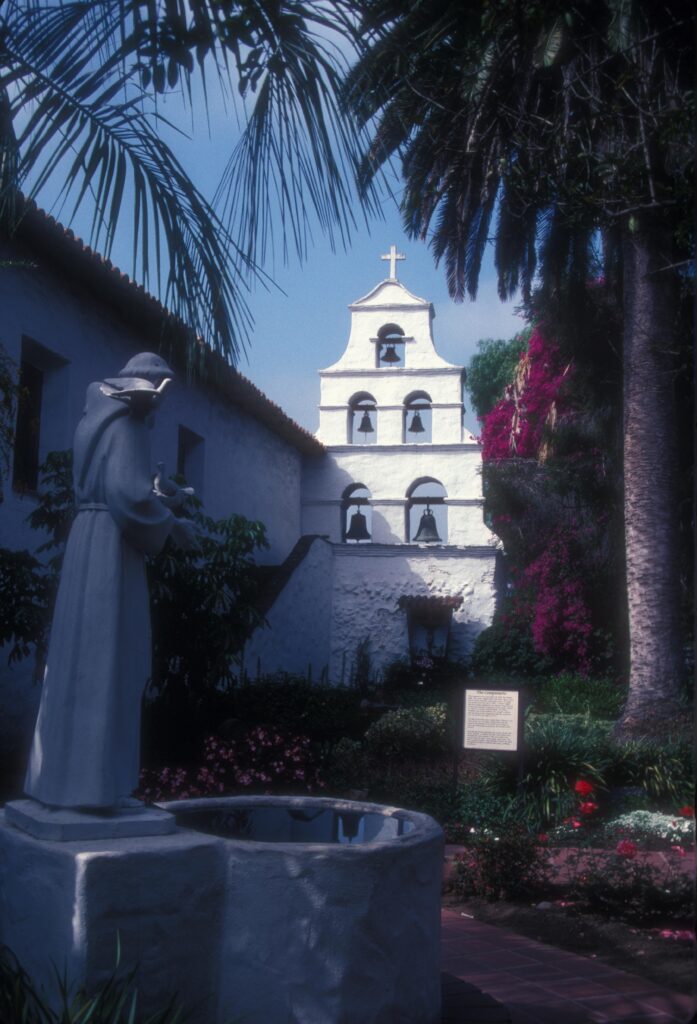
The present architecture features a striking bell wall with five bells and massive buttresses. Structures have been damaged, rebuilt and restored over centuries, so ask which fabric is original. This remains an active Catholic parish, while its visitor center interprets the history for tourists.
California’s mission network was a system of colonization and religious conversion, not an empty-land settlement story. Mission communities existed on Native homelands; policies controlling labor, movement, religion and family life brought lasting harm. A balanced visit includes living Indigenous perspectives as well as architecture and Catholic heritage. California State Parks describes forced labor, violence and disease as major parts of this history.
Visit Mission San Diego de Alcalá
Historic location: 10818 San Diego Mission Road, San Diego, CA 92108. City: San Diego. County: San Diego.
Pair the present site in Mission Valley with San Diego’s Presidio Hill for two very different views of the beginnings of Spanish colonization. The San Diego Trolley’s Mission San Diego stop offers an alternative to driving.
Open directions in Google Maps. Check current access, timed tours, ticket prices, worship restrictions, disability access, and events before setting out. Historic guidebook prices and schedules may be outdated.
Before the mission: Kumeyaay land, villages and knowledge
When Franciscan missionaries arrived in 1769, the region was not an empty frontier. Kumeyaay communities had long-established villages, political relations, languages, foodways and deep knowledge of the San Diego River, coast, valleys and deserts. The original Spanish mission was established by the presidio above the bay. Moving the mission in 1774 closer to Kumeyaay villages and the river was not only a geographic decision: it placed a colonial institution closer to communities whose land and labor it sought to control.
The Smithsonian National Museum of the American Indian educational collection explains the roots of the 1775 Kumeyaay resistance in the seizure of land, disruption of food-gathering areas and coercion of Native people into mission labor and Christian conversion. The November uprising destroyed much of the new compound. This moment deserves study not as a footnote to the missionary story but as Indigenous political action against colonization. The Journal of San Diego History offers a more detailed historical analysis of the revolt’s political alliances and competing accounts.
A second history stop: Mission Dam at Mission Trails Regional Park
The tourist church is not the only surviving mission-related landscape in San Diego. Farther up the San Diego River, the historic Mission Dam illustrates how agricultural expansion depended on control of water and compelled Indigenous labor. The National Park Service states that Spanish colonizers coerced Kumeyaay people into constructing the dam between 1809 and 1815. A visit to the dam and the park’s interpretive exhibits can broaden understanding beyond church architecture. Before heading out, check the park’s access and trail conditions; the dam is a historic site, not an invitation to enter the river or protected structures.
Mission San Diego: admission, public transit and a practical itinerary
Official visitor information checked October 20, 2026: the mission’s visitor page lists admission at $8 for adults, $5 for visitors 55+, active military and students, and $3 for children ages 6–12. These are posted figures, not a guarantee of future prices; verify before visiting. The church is an active parish, and admission for Mass is different from museum or visitor admission.
Without a car: San Diego Trolley’s Mission San Diego station is a practical option. The official mission visitor directions describe a short walk via Rancho Mission Road and San Diego Mission Road. For a fuller history day, combine today’s Mission Valley compound with the separate original-area landscape around Presidio Hill and the Mission Dam in Mission Trails Regional Park. They are three different places, so don’t use the mission entrance address for all three.
For school projects and travelers: photograph and label restored and historic portions accurately; note the 1769 founding and 1774 relocation separately; and distinguish present-day tourist services from eighteenth-century labor systems. Supplement the church’s account with Indigenous scholarship and Kumeyaay history resources. Historical sources differ in some details, so attribute disputed interpretations rather than treating one colonial record as the only account.
Featured photograph: Jerrye and Roy Klotz, MD / Wikimedia Commons, CC BY-SA 3.0. Photograph resized for web display.
Reliable sources and official visitor information
- California Missions Foundation — Mission San Diego de Alcalá history and heritage site
- Visit the mission / site operator — official website
- California State Parks — missions and historical chronology
Read this mission guide in Russian: Читать подробную статью о миссии на RusCali.com →
Continue your California mission trip
Explore all 21 California missions and plan your road trip · Read the statewide history guide · Browse California58 Travel.
Help us document California’s history: Support California58 independent and local journalism.
Support independent journalism for all Californians
Support reporting, public information and community coverage across California’s 58 counties.
Donate once by card ↗Support California58
Choose how to support California58:
Credit / Debit Card via StripeChoose an amount from $1. One-time support through the publisher's LINKERNO Stripe account.
Continue with PayPal Continue with ZelleZelle payments go to Vitaly Ataev Troshin. Please verify the recipient in your bank before sending. Availability depends on your bank.
Optional reader support. Contributions are not advertised as tax-deductible. Support does not influence editorial decisions.USEFUL SERVICES
Useful services from our ecosystem
AFFILIATED RESOURCE
Travel smarter worldwide
OptionTripAI-powered trip planning for journeys in California and around the world.
Explore OptionTrip →AFFILIATED RESOURCE
Free tax & property tools
TaxesTimeFree preliminary tax and property tools, including the Property Tax Savings Report.
Explore TaxesTime →AFFILIATED RESOURCE
California document support
LegalDocSVCDocument preparation support for self-represented Californians. Not a law firm and not legal advice.
Explore LegalDocSVC →WORK WITH CALIFORNIA58
Have a story, project or partnership idea?
California58 welcomes news tips, interviews, video projects, community partnerships, advertising and other California-focused collaborations.
Work with California58 →
COMMUNITY
Comments
Join the California58 conversation. You must be signed in to comment.
Create a free California58 account or sign in with an available social provider.